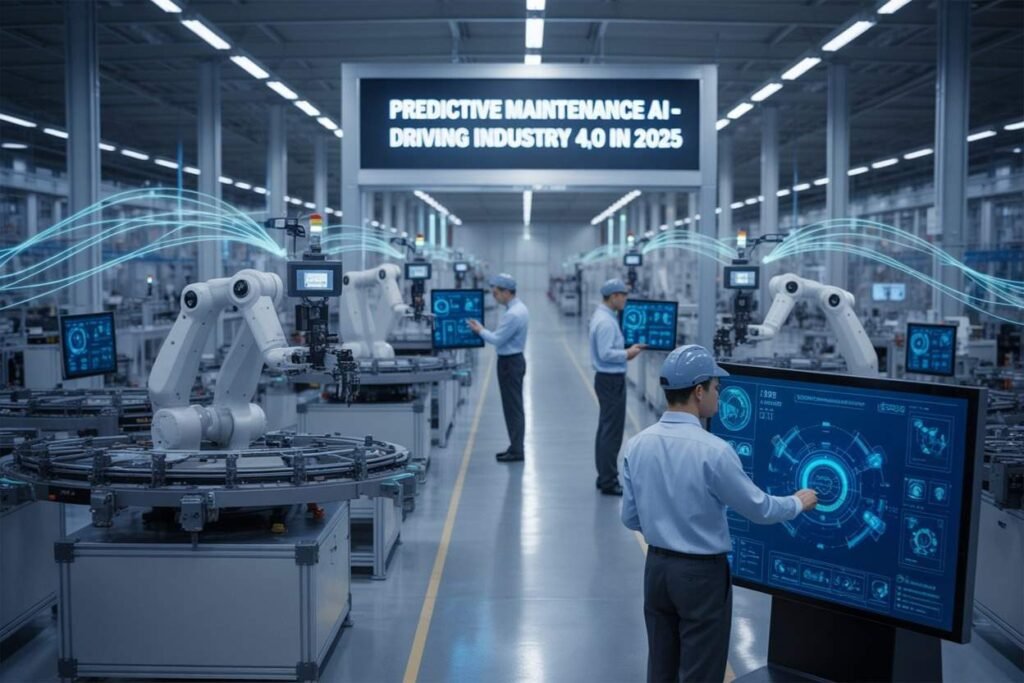
Machines used to fail without warning. Something would stop working, a line would go down, and a team would scramble to fix it. That was the norm for most of industrial history. Now it’s becoming the exception. Predictive maintenance powered by AI has shifted the model completely: factories no longer react to failures, they see them coming and prevent them. This shift is a core part of the broader transformation of AI applications across industries in 2026, and its financial and operational impact is significant enough that it has moved from pilot project to standard strategy in just a few years.
The numbers tell the story. Fortune 500 companies lose approximately $1.4 trillion annually due to unplanned outages, equivalent to 11% of total revenues, according to Siemens’ 2024 downtime report. In automotive manufacturing, a single idle production line costs up to $2.3 million per hour. Each hour of downtime now costs 50% more than it did in 2019 due to inflation, supply chain complexity, and higher production volumes. Preventing even a fraction of those losses more than justifies the investment.
The rise of Industry 4.0 and where it stands in 2026
Industry 4.0 describes the fourth industrial revolution: the integration of AI, automation, robotics, and data analytics into interconnected production systems. The factory floor is no longer a collection of machines running independently. It’s a network of smart equipment that communicates constantly, feeding live data into systems that can understand and act on what the data means.
In 2026, that vision has moved well past the conceptual stage. IDC predicts that more than 40% of manufacturers with production scheduling systems will have upgraded to AI by this year. Researchers and industry analysts are already talking about Industry 5.0, the next phase, which emphasizes human-machine collaboration rather than pure automation. The core idea is that intelligent systems handle the monitoring, analysis, and routine decision-making while humans focus on judgment, design, and oversight. Predictive maintenance sits at the center of this shift.
The maintenance evolution has three distinct stages. Reactive maintenance fixes things after they break. Preventive maintenance services equipment on a fixed schedule, which is better but still imprecise. Predictive maintenance is the third and most efficient stage: it uses real-time data to determine exactly when maintenance is needed, based on actual equipment condition rather than a calendar.
How AI makes predictive maintenance work
The intelligence behind predictive maintenance comes from machine learning models that learn what normal operation looks like for a specific machine, then flag anything that deviates from that baseline. A slight increase in vibration frequency might indicate a bearing wearing out. An unusual thermal signature in a motor might signal insulation degradation. These are signals a human maintenance team would miss entirely or catch only after significant damage had accumulated.
The models use a combination of supervised and unsupervised learning. Supervised models are trained on labeled data: examples of healthy operation and known failure modes. Unsupervised models look for novel patterns in unlabeled data, catching failure types that weren’t in the original training set. Together, they cover both known risks and unexpected problems. The longer the system runs, the better its predictions become, and false alarm rates drop as the model refines its understanding of what actually matters versus what is just normal variation.
The technology stack in 2026
Predictive maintenance in 2026 runs on five layers of technology working in concert.
IoT sensors are the foundation. They monitor vibration, sound, temperature, pressure, and electrical behavior in real time. Sensor costs have fallen dramatically over the past several years, which is one of the primary reasons adoption has accelerated so fast.
Edge computing allows analysis to happen directly at the machine rather than sending all data to a central server. This eliminates latency, which matters enormously in industrial environments where a millisecond delay in detecting a fault can cascade into much larger damage. Edge AI enables actions like automatic shutdown or load reduction to happen in real time without waiting for a cloud round-trip.
5G connectivity has become a significant enabler. Paired with edge AI, 5G provides the ultra-low-latency backbone that makes truly real-time industrial systems practical at scale, particularly in large facilities where running new cables is impractical.
Digital twins are virtual copies of physical machines that mirror real-world behavior in real time. Engineers can simulate failure scenarios, test maintenance interventions, and train AI models on synthetic data without ever touching the actual equipment or disrupting production.
Cloud analytics provides the scale for training large models and storing historical data across entire fleets of equipment. Models trained in the cloud are deployed to the factory floor, where edge systems handle real-time inference.
Generative AI: the newest layer
One of the most significant developments in predictive maintenance over the past year has been the integration of generative AI into these systems. Traditional machine learning needs large labeled datasets of real failure events to train on. Failures are, by definition, rare, which creates a data scarcity problem for the most important training signals.
Generative AI solves this by creating synthetic datasets that replicate rare failure scenarios. These synthetic examples teach models to recognize failure patterns they’ve never actually encountered in production. Digital twins powered by generative models can simulate multiple failure modes simultaneously, testing the prediction system against scenarios that might not occur for years in the real world but that need to be caught immediately when they do.
Voice and language interfaces are another generative AI addition. Technicians can now describe what they’re observing in plain language, and the system converts those observations into structured work orders linked to the relevant equipment records. This reduces documentation friction and captures field observations that might otherwise never make it into the dataset.
Industries leading the adoption
Manufacturing remains the largest adopter, for straightforward financial reasons. Production lines where a single machine failure can halt an entire facility have the clearest ROI case for predictive maintenance. Industrial robots, conveyor systems, CNC machines, and injection molding equipment are all common targets.
Energy and utilities have embraced AI maintenance extensively. Wind turbine operators use sensor networks to detect blade fatigue, bearing wear, and gearbox issues weeks before failure. Solar farm operators monitor inverters and electrical connections. The cost of repairing a failed wind turbine is substantial, and offshore facilities add the complication of difficult access, making early warning systems particularly valuable.
Transportation and logistics rely on predictive systems across aircraft engines, rail wheel wear, and trucking fleet health monitoring. Airlines in particular have been using AI-driven maintenance management for years, and the models have matured significantly. Rail operators in Europe and Asia are reporting measurable reductions in unplanned service interruptions through AI-based track and rolling stock monitoring.
Oil and gas operations use predictive maintenance to detect leaks, corrosion, and pressure anomalies early. The combination of high replacement costs, safety risk, and environmental liability makes early detection economically and ethically essential.
| Three approaches to industrial maintenance | ||
| Reactive | Preventive | Predictive (AI-driven) |
| Fix it when it breaks. Emergency repairs. Maximum downtime risk. | Scheduled service at fixed intervals regardless of actual condition. Can over-maintain healthy equipment. | Real-time sensor data analyzed by AI. Maintenance happens exactly when needed, before failure occurs. |
| High emergency labor costs. Cascading failures possible. | More cost-efficient than reactive. Still generates waste from unnecessary servicing. | Lowest maintenance cost per unit of production. Reduces emergency repairs by 30-50%. |
| No prediction capability. Equipment lifetime shortened by repeated stress failures. | Extends equipment life compared to reactive. Misses emerging issues between inspection cycles. | Maximum equipment lifespan. Can predict failures weeks or months ahead and auto-schedule parts orders. |
Real-world platforms in 2026
Siemens has consolidated its industrial IoT work under Insights Hub, the platform formerly known as MindSphere. It collects and analyzes data from industrial devices at scale, integrates OT and IT layers for low-latency edge analytics, and feeds machine learning models that predict maintenance needs across manufacturing, energy, and transportation deployments. Siemens’ edge architecture is a notable strength: it makes decisions locally without cloud latency, which is critical for real-time industrial applications.
PTC’s ThingWorx platform integrates IoT device data with analytical models and process visualizations, enabling rapid development of industrial applications and digital twin creation. IBM’s Watson Supply Chain links predictive maintenance data with inventory and logistics planning, aligning physical equipment health with supply chain operations.
Specialist platforms including Augury, SparkCognition, and Uptake are making AI-driven maintenance accessible to mid-sized manufacturers who don’t have the resources to build custom solutions. Plug-and-play sensor kits and cloud-based subscription models have lowered the barrier significantly from where it was even three years ago.
Challenges that remain real in 2026
Data quality is the most consistent obstacle. Models are only as reliable as the sensor data feeding them. Malfunctioning sensors, inconsistent timestamps, and incomplete historical records all degrade prediction accuracy. Establishing a clean, consistent data pipeline is a prerequisite that many organizations underestimate when planning implementation.
Legacy equipment integration remains a genuine engineering challenge. A factory with machines from the 1990s wasn’t designed to connect to anything, and retrofitting sensors onto older systems requires careful engineering. The cost and complexity of this retrofitting is a real barrier, though it’s getting easier as more retrofit solutions become commercially available.
Cybersecurity is an increasing concern that gets less attention than it deserves. A connected factory is an exposed factory. Industrial control systems and sensor networks are attractive targets, and the consequences of a successful attack on a production environment are severe. As edge AI systems take on more autonomous control, the security requirements around them need to be treated with the same seriousness as the AI itself.
The human side of intelligent maintenance
Predictive maintenance doesn’t reduce the role of maintenance teams. It changes it. Technicians move from reactive firefighting to proactive analysis and decision-making. Instead of being called in when something has already broken, they work from data: evaluating AI recommendations, planning interventions, and building understanding of how their specific equipment behaves over time.
This shift creates demand for a new set of skills. Understanding sensor data, interpreting model outputs, and knowing when to trust or question an AI recommendation are all capabilities that maintenance professionals are developing rapidly. The transformation is making industrial roles more analytical and more strategic, and in most cases where organizations have managed the transition thoughtfully, job satisfaction has followed. Similar intelligent systems are reshaping finance with the same logic of prevention over reaction: AI in fintech now detects fraud before it causes damage, automates compliance, and personalizes financial services in ways that parallel how predictive maintenance protects industrial operations before failures occur.