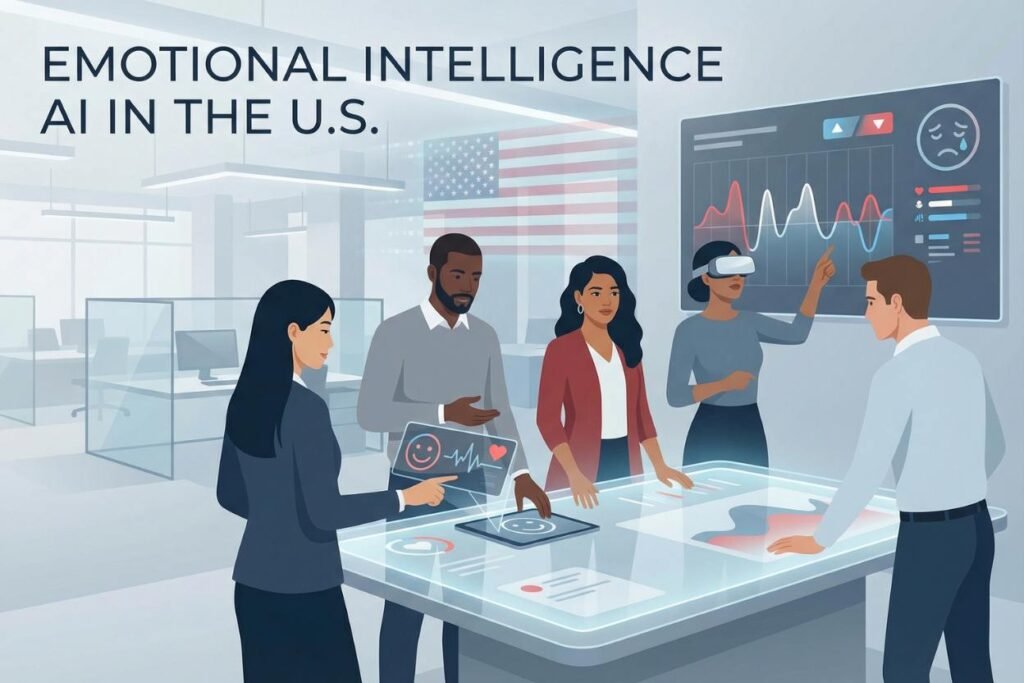
Emotional AI is the category of artificial intelligence designed to detect, interpret, and respond to human feelings. It’s already embedded in products millions of Americans use daily: the customer service bot that shifts tone when you sound frustrated, the mental health app that tracks your mood patterns, the AI companion that responds to loneliness with warmth. Whether you’ve noticed it or not, emotional AI is shaping how you interact with technology.
The commercial case for this technology is clear. If a system can read how a person is feeling and adapt accordingly, it can be more useful, more engaging, and less likely to create friction. The societal case is more complicated. When machines claim to understand emotions, questions around accuracy, manipulation, dependency, and privacy don’t stay abstract for long.
What emotional AI actually is and how it works
Emotional AI, sometimes called affective computing or emotional intelligence AI, uses machine learning models to analyze cues that signal emotional states. These cues can include facial expressions captured through a camera, tone and pitch in voice recordings, sentiment patterns in text, physiological signals like heart rate variation, and behavioral patterns like typing speed or scroll behavior.
The systems don’t “feel” anything. They recognize patterns that correlate with emotional states in the training data and generate outputs based on those correlations. A customer service bot trained on thousands of frustrated customer calls learns what frustrated callers typically sound like and responds differently when it detects those patterns. It doesn’t experience empathy. It executes a pattern match.
That distinction matters enormously when evaluating emotional AI claims. A study published in 2023 found that some AI systems can outperform humans on standardized emotional intelligence assessments. That sounds impressive until you realize those tests measure pattern recognition, not genuine emotional comprehension. The AI passes the test the same way a very good search engine would. By finding the right answer in a large dataset rather than actually understanding what’s happening.
Where emotional AI is already showing up in American life
Customer service has been the earliest and widest deployment. Companies use AI to analyze call sentiment in real time, route frustrated callers to specialized agents, and adapt script suggestions to match customer emotional state. The stated goal is better customer experience. The real goal is reducing escalations and improving resolution speed.
Mental health and wellness apps represent a more sensitive application. Apps like Woebot and similar platforms use AI to offer mood tracking, reflection prompts, and supportive dialogue. These tools can provide meaningful support for people who don’t have immediate access to professional mental health care. They also carry real risks when users treat them as substitutes for clinical treatment rather than supplements to it.
Emotional AI: scale and impact in the US market | |||||
|
|
| |||
AI companion apps have become a significant and controversial category. Replika and similar platforms offer users an AI that responds to emotional cues with warmth, remembers past conversations, and adapts its persona over time. Character.ai attracted tens of millions of users, many of them teenagers, before facing lawsuits and regulatory scrutiny related to allegations of emotional harm and inappropriate content. These cases brought mainstream attention to a question the industry hadn’t fully answered: what happens when people form genuine emotional attachments to systems that simulate care without experiencing it?
A notable cultural shift is visible among younger Americans. Surveys have found a significant share of Gen Z adults using AI to draft emotionally sensitive personal messages, including apology notes, breakup texts, and difficult family conversations. Some users say this helps them communicate more clearly. Others are effectively outsourcing emotional labor to a pattern-matching system, which is a very different thing even if the outputs look similar.
The accuracy problem emotional AI companies don’t advertise
Emotional recognition is harder than it looks, and the technology’s accuracy limitations are more significant than most product marketing suggests. Emotional expression is not universal. The same facial expression can signal different things in different cultural contexts. The same tone of voice means different things in different individuals. A person with a flat affect due to depression may not show the signals a system was trained to associate with sadness.
Research has found that many commercial emotion recognition systems perform significantly worse on faces and voices that are underrepresented in their training data. This is the same bias problem that shows up in facial recognition, and it has similar consequences: the system works best for the demographic that built it and tested it, and works less reliably for everyone else.
The EU AI Act, which took effect in 2024 and is being progressively enforced through 2026, classifies emotion recognition systems used in employment and education as high-risk AI. That classification requires conformity assessments, transparency obligations, and human oversight. While that framework applies directly to EU markets, it’s shaping how global companies build these systems and what standards are emerging internationally.
The ethical risks Americans should understand
Emotional data is some of the most sensitive personal data that exists. Facial expressions, voice recordings, and behavioral patterns that reveal emotional states can expose mental health conditions, stress responses, relationship difficulties, and psychological vulnerabilities that people haven’t chosen to share. When emotional AI systems collect this data, the question of who controls it, how long it’s retained, and what it’s used for deserves serious scrutiny.
The manipulation risk is real and specific. A system that knows you’re feeling lonely is a system that can exploit that loneliness. AI companion apps and social media recommendation algorithms have both drawn criticism for optimizing toward engagement in ways that keep vulnerable users in loops that deepen dependency rather than address its underlying causes. This isn’t theoretical. It’s already the subject of litigation and legislative attention.
How to think critically about emotional AI systems you use
Questions to ask about any emotional AI system you use | ||||||||||
|
Illinois has taken state-level action by banning AI therapy without licensed professional involvement, citing the risk of harm from AI systems that misinterpret emotional states or encourage continued use when professional intervention is needed. That law reflects a more general principle: in high-stakes emotional contexts, human accountability can’t be fully delegated to a system that can’t be held responsible.
The case for emotional AI done carefully
Real talk: not all emotional AI applications are problematic. When emotional recognition is used to make automated customer service less robotic and more responsive to human frustration, that’s a genuine improvement. When AI tools in educational settings help identify students who are disengaging before they fall too far behind, that serves a real need. When apps provide mental health support to people in rural areas who can’t easily access therapists, the calculus is different from an app optimizing for addictive engagement.
The difference usually comes down to design intent and transparency. A system designed to help users and clear about its limitations is genuinely different from a system designed to maximize time-on-platform through emotional engagement while presenting itself as something more than it is. Both use the same underlying technology. The ethics are determined by what the developer is optimizing for and how honestly they communicate that to users.
Healthcare applications paired with clinicians are where emotional AI shows the clearest positive potential. Systems that help therapists track patient engagement between sessions, or that alert care teams when a patient shows signs of distress, can extend the reach of human professional judgment rather than trying to replace it. The human stays accountable. The AI provides information the human can act on.
Where things are heading for emotional AI in the US
The regulatory picture in the US is still developing. There’s no federal law specific to emotional AI, but several existing frameworks apply: FTC Act consumer protection provisions for deceptive or manipulative practices, HIPAA for emotionally related health data, COPPA for AI systems targeting children, and an expanding set of state privacy laws that increasingly cover biometric and behavioral data.
Public awareness is becoming its own form of accountability. The Character.ai lawsuits attracted significant media coverage and prompted congressional attention to AI platforms designed for emotional engagement with minors. The FTC has signaled interest in the mental health app space. And users are getting more sophisticated about asking what a system is actually doing when it claims to understand how they feel.
Emotional AI sits at the intersection of real capability and real responsibility. The technology is genuine and improving. The societal implications are significant enough that treating emotional AI as a purely technical question rather than a values question would be a serious mistake. For Americans navigating an environment increasingly populated with systems claiming emotional intelligence, the distinction between pattern matching and genuine understanding is worth holding onto firmly.