The world in 2026 looks different because of one driving force: artificial intelligence. It’s not a distant concept anymore. It’s woven into the fabric of daily life, from how people shop online to how factories predict equipment failures before they happen. AI has moved well beyond experimentation and entered a phase of widespread practical deployment across nearly every sector. What’s changed from a year ago is not just scale, but depth. The systems being built now are more capable, more autonomous, and more embedded in core operations than anything deployed before.
What makes this moment significant is the shift from “AI as a feature” to “AI as infrastructure.” Companies, governments, and individuals are using it to solve real problems, improve efficiency, and create experiences that were impossible just a few years ago. The shift is not about replacing humans but about building systems that amplify what people can do.
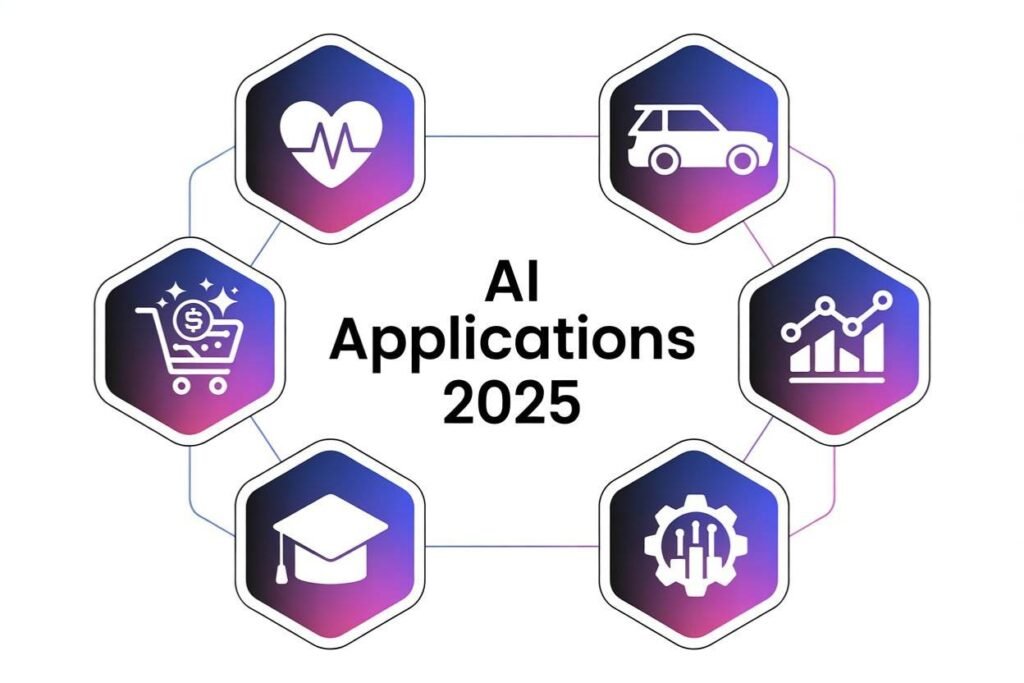
This overview covers six major sectors where that transformation is most visible right now: healthcare, transportation, retail, finance, education, and manufacturing. Each one tells a different story about how intelligence can be embedded into complex systems to make them faster, safer, and more personalized.
Healthcare AI: from experiments to daily clinical tools
Medicine has always relied on precision, and AI is taking it to a new level. Deep learning models scan X-rays, MRIs, and CT scans to detect patterns invisible to the human eye. These tools don’t replace radiologists; they catch what might otherwise be missed, particularly under the volume pressure most radiology departments face. The National Institutes of Health has reported that AI systems demonstrate higher sensitivity in detecting lung cancer and diabetic retinopathy than traditional methods.
Predictive analytics is another active front. Hospitals monitor patients in real time using algorithms that can predict complications before they become critical. If vitals show unusual patterns, the system alerts clinical staff immediately. Agentic AI is now being piloted for clinical workflow automation, with models that can autonomously plan and execute documentation tasks.
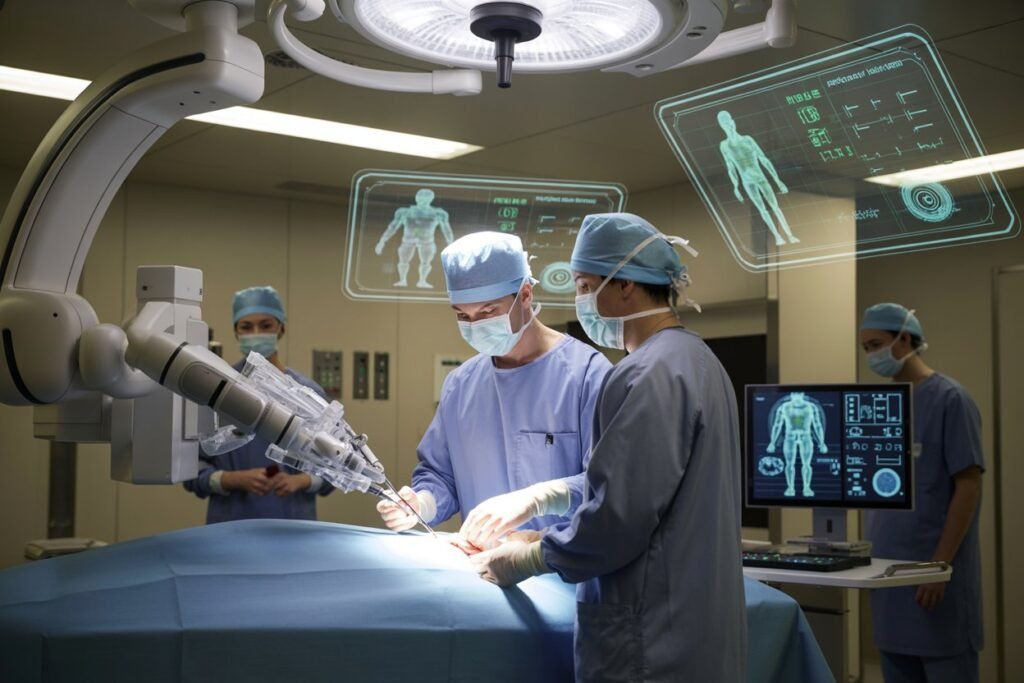
One of the most rapidly adopted tools in 2026 is the ambient AI scribe. Microsoft Dragon Copilot and similar systems listen to clinical consultations and generate structured notes automatically, reducing the documentation burden that drives physician burnout. The World Economic Forum notes that AI has potential to help bridge the projected shortfall of 11 million health workers by 2030. Drug discovery timelines are compressing from years to months as agentic AI generates and simulates new molecular candidates. Surgical robots guided by AI assist in delicate procedures, improving precision and reducing recovery time. The detailed picture is in our full healthcare AI examples for 2026.
Autonomous vehicles and transportation: the robotaxi era begins
Transportation is being rebuilt from the ground up. Waymo, backed by Alphabet, now operates fully driverless commercial service in 10 US cities including San Francisco, Phoenix, Los Angeles, Atlanta, and Dallas. The company has logged over 200 million autonomous miles on public roads and is targeting 1 million weekly rides by the end of 2026. Tesla launched its unsupervised robotaxi service in Austin in January 2026, operating roughly 40 modified Model Y vehicles, with Cybercab production set to begin in April 2026 pending federal regulatory approval.
The impact extends well beyond passenger cars. Autonomous freight is maturing rapidly. Companies like Torc Robotics and Aurora are operating AI-driven trucks on US highways. Truck platooning, where multiple vehicles travel in coordinated convoys managed by AI, reduces fuel consumption and improves highway safety. Amazon-backed Zoox is expanding robotaxi operations to Austin and Miami.
Cities are getting smarter in parallel. AI-managed traffic systems adjust signals dynamically based on live congestion data, cutting average travel times and reducing emissions. Public transport adapts to real-time passenger demand instead of fixed timetables. Drones deliver medical supplies to remote areas and inspect infrastructure without putting workers at risk. The full breakdown of where this is heading is in our coverage of autonomous vehicles and AI in transportation 2026.
E-commerce AI personalization: from recommendations to agentic shopping
Online retail has been transformed by AI personalization, and in 2026 it’s entering its most significant phase yet: agentic commerce. Traffic to US retail sites from generative AI sources grew 4,700% year-over-year according to Adobe’s 2025 holiday analysis. Revenue per visit from AI-referred shoppers runs 84% higher than from traditional traffic channels. Ninety-one percent of consumers say they’re more likely to shop with brands that offer relevant recommendations.
Recommendation engines remain foundational. They analyze browsing patterns, purchase history, and session behavior to surface products shoppers are genuinely likely to want. But the leading edge has moved further. Agentic AI can now act on a shopper’s behalf: browsing, comparing, filtering, and completing purchases based on preferences stated in natural conversation. Braze’s 2026 Customer Engagement Review puts 19% of consumers already using AI agents for brand interactions, with that figure expected to reach 46% by year end.
Visual search has become a mainstream discovery tool. Amazon processes 4 billion monthly shopping-related visual searches through Google Lens integration. Dynamic pricing adjusts in real time based on individual behavior and inventory. AI-powered cart abandonment recovery sequences reclaim approximately 35% of carts that would otherwise be lost. Conversational commerce chatbots handle queries, recommend products, and guide purchases with memory of past interactions. The full landscape is covered in our piece on e-commerce AI personalization and the future of retail.
Fintech AI: from chatbots to agentic finance
Finance has always been about trust and precision, and AI is reinforcing both at scale. Around 80% of fintech firms now use AI across multiple business functions, with fraud detection leading adoption at 46%. Fraud detection models analyze hundreds of behavioral signals simultaneously and flag or block suspicious transactions before they clear, continuously adapting without manual rule updates.
Credit scoring has become more inclusive. Alternative data including utility payments, rent history, and mobile money behavior now feed models that extend access to people that traditional bureau-based scoring excludes. Zest AI’s machine learning underwriting has cut auto loan losses by 23% annually while approving more applicants.
The defining development of 2026 in fintech is agentic AI: systems that don’t just inform but act. Wells Fargo, BDO, and others are piloting AI agents that execute transactions end-to-end, monitor subscription renewal risk, and identify upcoming bill payments with minimal human involvement. The GENIUS Act, enacted in the US in July 2025, created the first comprehensive regulatory framework for stablecoins, giving the industry clearer ground to build on. Algorithmic trading has gained a new dimension through “quantamental” approaches that combine AI’s pattern-recognition speed with fundamental analysis context. The complete picture is in our analysis of fintech AI applications transforming finance in 2026.
| Six industries being transformed by AI in 2026 | ||
Healthcare AI imaging, predictive analytics, drug discovery, robotic surgery, ambient AI scribes reducing documentation time by 40% | Transportation Waymo in 10 cities, Tesla Cybercab production beginning, autonomous freight, smart traffic systems, urban air mobility testing | Retail Agentic commerce, AI recommendation engines, dynamic pricing, visual search processing 4B monthly queries, conversational checkout |
Finance Agentic AI transactions, real-time fraud detection, inclusive credit scoring, quantamental investing, AI-first compliance automation | Education Adaptive learning platforms, AI mentors, reskilling 120M at-risk workers, in-flow learning, EU AI Act literacy requirements | Manufacturing Predictive maintenance, edge AI plus 5G, generative AI for synthetic failure data, digital twins, 30 to 50% downtime reduction |
AI and workforce skills: reskilling at a scale the world hasn’t seen before
Education is no longer a one-size-fits-all system, and it’s facing one of its greatest tests. The World Economic Forum projects that by 2030, 170 million new jobs will be created while 92 million are displaced, a net gain of 78 million positions. But around 80% of the global workforce will need new AI-related skills by 2027 to be competitive for those roles. Workers with demonstrable AI skills command wage premiums up to 56% higher than peers without them.
AI-driven adaptive learning platforms are a central tool in this transition. They track individual progress, adjust content difficulty dynamically, and identify exactly where understanding breaks down. Virtual AI mentors provide personalized feedback at any hour, in multiple languages. The EU AI Act now requires employers to ensure staff have sufficient AI literacy, adding a regulatory dimension to what was previously a market-driven choice.
Corporate learning is shifting from scheduled workshops to in-flow learning: AI systems that deliver coaching and guidance inside the tools people already use at work, in the moment it’s needed. BCG research shows this embedded approach produces significantly better retention and skill transfer than standalone training. One counterintuitive finding from Gartner in 2026: 50% of organizations are expected to require AI-free skills assessments to address growing concerns about critical thinking atrophy from over-reliance on generative AI. The full landscape of this transformation is in our coverage of AI for workforce skills 2026.
Predictive maintenance AI: intelligent machines running Industry 4.0
Manufacturing has entered an era where machines communicate their own health status. Predictive maintenance uses AI to analyze sensor data from industrial equipment, detecting signs of wear or malfunction weeks or months before breakdowns occur. The cost of not doing this is substantial: Fortune 500 companies lose $1.4 trillion annually to unplanned outages. In automotive manufacturing alone, an idle production line costs up to $2.3 million per hour.
The technology stack has matured significantly. IoT sensors monitor vibration, temperature, pressure, and power consumption continuously. Edge AI processes data locally at the machine, eliminating cloud latency and enabling real-time responses like automatic shutdown when a fault is detected. 5G connectivity provides the ultra-low-latency backbone for large facilities where cable infrastructure is impractical. Digital twins create virtual replicas of physical equipment, allowing engineers to simulate failure scenarios without touching the real machines.
Generative AI has added a new capability: synthetic failure datasets. Real failure events are rare by definition, which creates a training data problem. Generative models solve it by creating realistic simulated failure scenarios that teach prediction systems to recognize problems they’ve never seen in production. Voice-to-work-order interfaces allow technicians to describe what they observe in plain language, which the system converts into structured maintenance records.
Siemens operates its industrial IoT platform under the Insights Hub brand, providing predictive analytics and edge integration across manufacturing, energy, and transportation. PTC’s ThingWorx integrates device data with digital twin models. Specialist platforms from Augury, SparkCognition, and Uptake are making these capabilities accessible to mid-sized manufacturers. The full breakdown of how this works across industries is in our piece on predictive maintenance AI driving Industry 4.0 in 2026.
What connects all of it
The applications of AI in 2026 are not isolated innovations. They form a connected ecosystem of intelligent systems that touches nearly every aspect of modern life. From hospitals that detect diseases earlier to factories that prevent equipment failures, from personalized shopping to financial services that reach the previously excluded, AI is part of the infrastructure of how the world works now.
What ties these transformations together is a consistent pattern: augmentation rather than replacement. The technology handles high-volume, repetitive, and pattern-recognition work so that people can focus on judgment, creativity, and the kind of work that requires genuine human understanding. That partnership is reshaping industries while creating new categories of work and skill.
The challenges are real and shouldn’t be minimized. Bias in training data, governance gaps, data privacy risks, and unequal access to AI-powered services are all active problems requiring active solutions. The organizations and governments that get the most value from AI in the next five years will be those that treat these as engineering and policy problems to solve rather than trade-offs to accept.
The pace of change is not slowing. Models are becoming more capable, sensors cheaper, and deployment faster. The question for anyone navigating this shift is not whether to engage with AI but how to do it in a way that delivers genuine value while managing the real risks. That’s the actual challenge of 2026, and it’s a more interesting one than the simpler questions that dominated the conversation a year ago.