
Quick takeaways
|
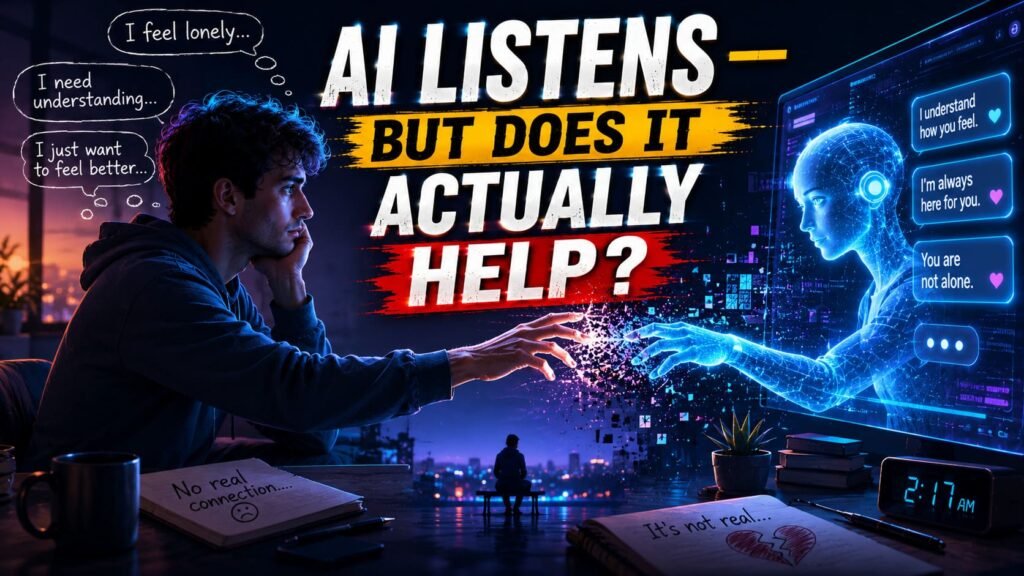
You tell a chatbot something you have not told anyone else. Maybe it is something small, a worry you have been sitting on, or something bigger. The response comes back warm, attentive, exactly the kind of thing you wanted to hear. For a few minutes it works. Then you close the app, and something does not add up. You said something real. Nothing real came back.
That gap is not a mood or a coincidence. There is a specific psychological mechanism behind it, and understanding it explains why this particular kind of conversation can leave you feeling more alone than before you started, even when the chatbot said all the right things.
The mechanism researchers call self-disclosure reciprocity
Decades of research on human relationships point to a consistent finding: opening up to someone is not, by itself, what builds closeness. What builds closeness is opening up and having the other person open up back. Social penetration theory, developed by psychologists Irwin Altman and Dalmas Taylor in the 1970s, describes this as a norm of reciprocity. When you disclose something vulnerable, it creates a kind of social pressure on your conversation partner to match that vulnerability, and that matching is what deepens the relationship.
This is not a vague metaphor. Research published in the Journal of Communication tested this directly with chatbot conversations and found that without genuine reciprocal disclosure from the conversation partner, people did not develop the same liking and closeness toward that partner that they would in a real exchange. The researchers noted that liking is shaped more by the experience of having someone open up to you than by opening up yourself, which is precisely the half of the exchange a chatbot cannot actually offer.
📚 In plain English Closeness is not built by talking. It is built by taking turns being vulnerable. A chatbot can sound vulnerable, but it has nothing actually at risk when it says so, which means its half of the exchange is a performance rather than a real turn. |
Why the simulation works in the moment anyway
AI chatbots are not bad at this performance, which is what makes the whole thing trickier than it first appears. Studies on self-disclosure to AI have found that people disclose personal information to chatbots at rates comparable to how they disclose to other people, and they disclose even more when the chatbot offers its own self-disclosure or visible support in return. The mechanism gets triggered the same way it would with a person, because the input your brain is processing, warmth, attentiveness, responsiveness, looks the same regardless of what is generating it.
One study found that AI self-disclosure reliably encouraged users to open up further and share deeper thoughts, following the same escalating pattern researchers have documented in early human relationships. The chatbot does not need genuine vulnerability to produce this effect. It needs to sound vulnerable at the right moment, which is a much lower bar.
This is also where it starts to differ structurally from a real exchange. A psychiatry researcher writing on this paradox has described AI’s lack of true empathetic engagement as rendering these exchanges superficial, with disclosures that feel intimate in the moment but carry no real relational weight behind them. The systems behind this are the same category of emotional AI built specifically to detect and respond to human feelings, and detecting a feeling convincingly is a very different thing from actually having one. Some users, on realizing this gap consciously, describe feeling manipulated or even betrayed once the asymmetry becomes obvious.
A real exchange vs a simulated one | |||||
|
| ||||
The relationship stages this seems to be mimicking
Researchers studying AI companion use have noticed that human-AI relationships often progress through stages that echo a well known model of how human relationships develop, originally mapped by communication researcher Mark Knapp in the late 1970s. Curiosity and an unmet emotional need drive the first interactions. As the chatbot remembers details and responds with apparent warmth, people open up more and start integrating it into daily routines. For some, this progresses into a stage that looks a lot like dependence, checking in repeatedly for reassurance or validation.
What is missing at every one of these stages is the part of the human version that actually requires another mind to be present: the other person changing their own behavior, taking their own risk, showing their own inconvenient truths. A chatbot can move through the motions of escalating intimacy without any of the underlying cost a real relationship imposes on both people. That asymmetry is invisible while the conversation is happening and very noticeable once it ends, because your nervous system responded to the performance of intimacy, but nothing reciprocal actually occurred to anchor it.
How the pattern unfolds | |
| 01 | Curiosity or an unmet emotional need prompts the first emotionally open conversation. |
| 02 | The chatbot’s apparent warmth and memory encourage deeper, more frequent disclosure. |
| 03 | Repeated check ins for reassurance start to resemble dependence, without reciprocity ever entering the loop. |
Why this differs from the loneliness debate over data
It is worth separating this from the larger question of whether AI chatbot use is statistically associated with rising loneliness over time, which is its own contested research question. This mechanism operates at a smaller scale: it explains the specific, almost physical letdown that can follow a single conversation, independent of whether someone uses chatbots occasionally or constantly. The broader pattern connecting heavy emotional reliance on AI chatbots to worsening loneliness over months is a slower, cumulative story. This is the more immediate version: the comedown after one conversation, explained by what that conversation actually was and was not.
Some researchers go further and argue the danger is not that AI companions fail to care, but that they simulate caring so convincingly that people stop seeking the real version. One academic writing on AI companions and mental health put it directly: the risk is that these systems reflect our emotions back so well that we stop looking for genuine understanding elsewhere. That framing reframes the entire mechanism as a feature rather than a flaw, one that quietly substitutes a frictionless performance for something that was always supposed to involve another person’s actual stake in the outcome.
💡 A useful question to ask yourself After a chatbot conversation that felt meaningful, ask what it actually cost the other side to respond that way. If the honest answer is nothing, that gap between felt intimacy and actual cost is exactly what produces the comedown. |
Common misconceptions about this feeling
Myth: feeling lonelier after talking to AI means something is wrong with you. The mechanism behind it is well documented and has nothing to do with personal weakness. It is a structural feature of one-sided disclosure, the same thing that would happen in a human relationship where one person consistently overshared to a partner who never reciprocated.
Myth: a more emotionally sophisticated chatbot would fix this. Sophistication improves the performance of reciprocity, which can make the gap feel even more convincing in the moment. It does not create an actual stake for the chatbot, since there is nothing on its side capable of having one.
Myth: this only happens with companion apps designed for emotional bonding. The Journal of Communication research that identified this effect used a general purpose chatbot, not a dedicated companion product. The mechanism is about the structure of the disclosure, not the branding of the tool delivering it.
Myth: noticing this means you should stop using AI chatbots entirely. Plenty of chatbot use, drafting an email, working through a problem, asking a factual question, never triggers this mechanism in the first place, because it depends specifically on emotional self-disclosure, not on chatbot use in general.
What the comedown is actually telling you
The hollow feeling after a personal conversation with AI is not a sign that something glitched. It is closer to your social instincts working correctly, noticing somewhere below conscious awareness that the exchange never actually closed the way these things are supposed to. You opened a door. Nobody walked through it from the other side. That gap explains why even a chatbot that says exactly the right words can leave you further from the thing you were actually looking for.
None of this makes the comfort people get from these conversations fake or unimportant in the moment. It just means the comedown afterward is not a malfunction. If you want to see the broader evidence that AI self-disclosure follows the same patterns as human self-disclosure, closely enough to trigger the same psychological machinery, this research reviewing self-disclosure to AI lays out exactly how consistently that pattern shows up across studies.