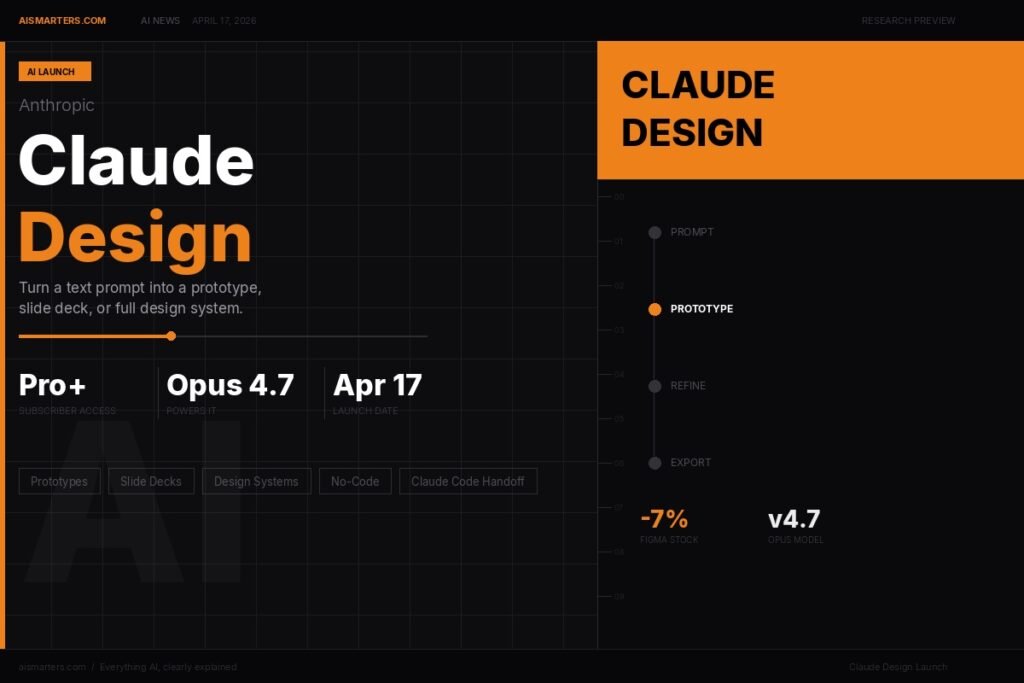

- Anthropic launched Claude Design on April 17, 2026, currently in research preview
- It generates prototypes, slides, and design systems from text prompts
- Powered by Claude Opus 4.7, Anthropic’s latest vision model
- Reads your codebase to auto-apply your team’s design system across every project
- Designs can be exported to Canva, PDF, PPTX, HTML, or handed off to Claude Code
- Available to Pro, Max, Team, and Enterprise subscribers; usage is tracked separately
- Figma stock dropped 7% within hours of the announcement
Anthropic just launched Claude Design: Figma’s stock just dropped 7%
You wake up Friday, open Twitter, and see that Figma’s stock has tanked 7%. No earnings miss. No scandal. Just Anthropic announcing a new product called Claude Design.
That reaction says a lot about what the industry thinks is happening here. Claude Design is Anthropic’s first visual creation tool, and it launched on April 17, 2026, in research preview. It lets you go from a text prompt to a working prototype, slide deck, or one-pager. No Figma, no Canva, no design software required. This is what it does, who it’s for, and why people are paying attention.
What Claude Design actually is
The simplest way to describe it: you type what you want, and Claude builds a first version. From there, you refine it through conversation, inline comments, direct edits, or custom sliders that Claude itself generates for your specific project.
So if you ask it to “prototype a serene mobile meditation app with calming typography and a clean layout,” it does that. You can then ask it to try a dark mode version, adjust the spacing, or swap the color palette. All through plain conversation.
But the more interesting part is what happens before you type anything. During onboarding, Claude reads your codebase and design files to build a custom design system for your team. Every project you create after that automatically uses your colors, fonts, and components. You can maintain more than one design system, and Claude remembers the rules across projects.
Input options go beyond text prompts. You can upload reference images, existing documents (DOCX, PPTX, XLSX), or use a web capture tool to pull elements directly from your live website. If you’re prototyping a redesign, that last one is genuinely useful: your prototype actually looks like your product from day one.
The handoff loop with Claude Code
Here’s what separates Claude Design from a fancier version of Canva. When you’re done designing, you can hand everything off to Claude Code with a single instruction. Claude packages the design into a handoff bundle that carries the visual specs and design intent directly into code generation.
That creates a closed loop: idea → prototype → production code, all inside Anthropic’s ecosystem. Brilliant, the education tech company, tested this in early access. Their senior designer reported that pages requiring 20+ prompts in competing tools needed only 2 in Claude Design. Datadog’s product team said what used to be a week-long brief-to-review cycle compressed into a single conversation.
Not everyone wants to end up in Claude Code. Export options include PDF, PPTX, HTML, standalone URLs, and Canva, where the design becomes fully editable and collaborative. Anthropic is clear that Claude Design is meant to complement Canva, not replace it. Whether that framing holds up long-term is another question.
What it runs on
Claude Design is powered by Claude Opus 4.7, Anthropic’s most capable publicly available model as of this week. The company says Opus 4.7 is significantly better than its predecessor at graphic design tasks and more accurate at interpreting reference images, both qualities that matter directly for how Claude Design performs.
Usage is tracked separately from your standard Claude chat and Claude Code limits. On paid plans, Claude Design has its own weekly allowance. Once you exceed it, you move to pay-as-you-go token costs. One early tester at The New Stack burned through 50% of their weekly limit building a design system, a news website prototype, and a short explainer video. Token consumption is real.
| Feature | Details |
|---|---|
| Powered by | Claude Opus 4.7 |
| Input types | Text prompt, image upload, DOCX / PPTX / XLSX, URL capture |
| Export formats | PDF, PPTX, HTML, URL, ZIP, Canva, Claude Code handoff |
| Who gets access | Pro, Max, Team, Enterprise (research preview) |
| Usage tracking | Separate weekly limit from chat and Claude Code |
| Design system | Auto-applied from your codebase and design files |
Source: Anthropic Labs, April 17 2026
Who can access it
Claude Design is available in research preview to Claude Pro, Max, Team, and Enterprise subscribers. It’s rolling out gradually throughout Friday. Enterprise accounts have it off by default. Admins need to enable it manually.
Enterprise users also get a one-time credit worth roughly 20 typical prompts before usage starts counting against organizational spend. That credit expires July 17, 2026.
Who it’s actually built for
Anthropic is direct about the target audience: founders, product managers, and anyone who needs to get from an idea to something visual fast, without a design background or a Figma license. The product documentation says “you don’t need to be a designer to get great results,” with a note to be specific about what you’re building, who it’s for, and what matters most.
Real designers aren’t excluded. Anthropic frames it as giving designers “room to explore widely,” which means faster iteration and more concepts in less time. Whether working designers will actually use it that way, or whether it eats into junior design work, remains to be seen. A graphic designer interviewed by The Register said the corporate design world, where creativity is constrained and output has to match existing standards, is probably where this makes the biggest dent.
|
01. Onboarding Claude reads your codebase and design files to build your team design system |
| | |
|
02. Prompt Describe what you need in plain text, or upload a reference image or doc |
| | |
|
03. Refine Iterate via conversation, inline comments, direct edits, or custom sliders |
| | |
|
04. Export or hand off Send to Canva, export as PDF / PPTX / HTML, or pass to Claude Code to build it |
Common misconceptions about Claude Design
Misconception 1: It’s just Canva with a chat interface. The design system feature changes the comparison. Canva doesn’t read your codebase and apply your visual language automatically. Claude Design does, and then it hands the result to a code generator that can build the actual product.
Misconception 2: It replaces professional designers. For now, it handles well-defined briefs and repeatable design tasks. The kind of design work that requires reading a client’s emotional needs, navigating organizational politics, or pushing visual ideas past what’s obvious. That’s not what this is doing yet.
Misconception 3: Anthropic built this independently of Canva. Canva’s Design Engine actually powers parts of Claude Design. The relationship has been building since July 2025, when Canva launched an MCP connector for Claude. Claude Design is the deepest expression of that partnership so far, with Canva positioned as the editing layer once a design leaves Anthropic’s interface.
Misconception 4: Figma is the only casualty here. Claude Design also puts pressure on Lovable and other AI design services. More broadly, it’s a signal that Anthropic is moving from foundation model provider toward a full-stack product company that wants to own the path from rough idea to shipped product.
The bigger picture
Anthropic hit roughly $20 billion in annualized revenue in early March 2026 and reportedly surpassed $30 billion by early April. The company is in early talks with Goldman Sachs, JPMorgan, and Morgan Stanley about a potential IPO as early as October 2026.
Claude Design isn’t a distraction from that trajectory. It’s part of it. The company built Claude Code, then Claude Cowork, and now Claude Design. The pattern is a product suite that covers the full arc of knowledge work: coding, task automation, and now visual creation. What Anthropic is describing is a system where one conversation can take an idea from prompt to prototype to production.
That’s a significant claim. The research preview phase means it’s still being tested and refined. But the speed at which Anthropic is shipping, and the reaction from the market when they do, suggests this one is worth watching closely.