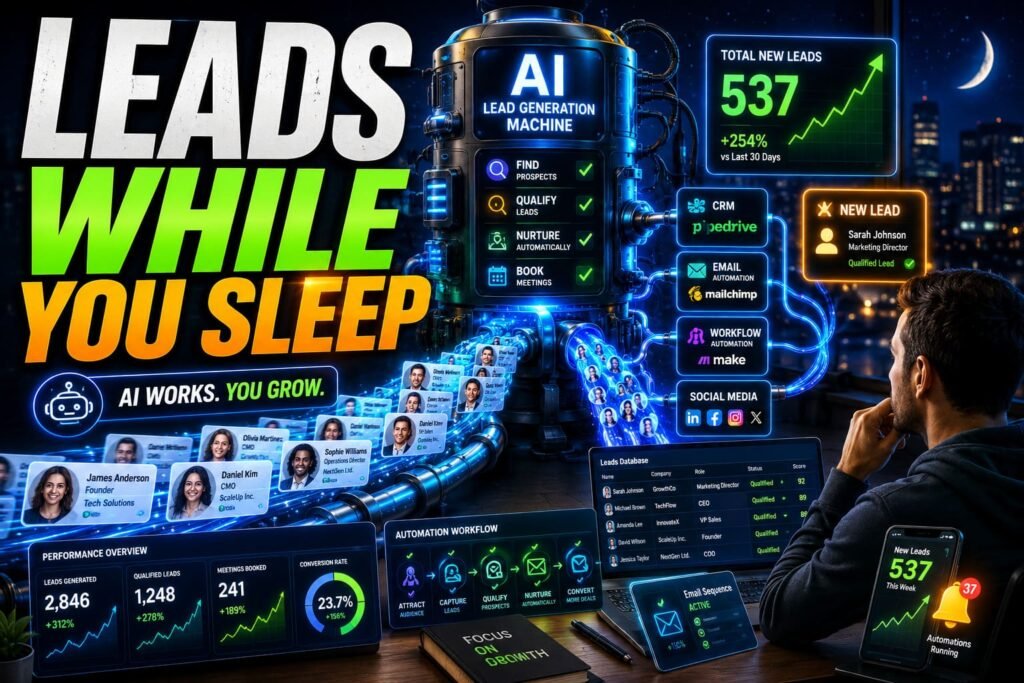
- Lead generation automation has four real stages: finding prospects, enriching their data, scoring them against your ideal customer profile, and personalizing outreach.
- Most teams automate one stage and leave the rest manual. The bigger gains come from connecting all four so a lead moves through the pipeline without anyone touching it until it’s qualified.
- Waterfall enrichment, querying multiple data sources in sequence, lifts contact data accuracy from around 20 percent to 80 percent compared to single-source lookups.
- AI-personalized outreach based on actual signals (a job change, a funding round, a tech stack detail) performs meaningfully better than name-token templates, and the gap is growing as spam filters improve.
- The work that should stay human: deciding who counts as a good-fit customer in the first place, and the actual sales conversation once a lead responds.
A lot of B2B lead generation still runs the way it did a decade ago, just with better spreadsheets. Someone builds a list, someone else looks each company up to figure out if it’s worth contacting, someone writes an email, and somewhere in there a CRM gets updated, usually a few days after the fact and usually missing half the fields.
What’s changed isn’t that AI writes better cold emails, though it does. It’s that the steps before the email, finding the right companies, figuring out who to contact, pulling together enough context to make the message worth opening, can now happen automatically and in sequence, so that by the time a person looks at a lead, most of the groundwork is already done.
The four stages, and why most teams only automate one
Lead generation breaks down into finding prospects, enriching their data, scoring them against your ideal customer profile, and personalizing outreach. Each of these has its own category of tools, and that’s part of the problem. A team might use one tool to build a list, manually export it, paste it into an enrichment tool, manually review the results, then hand a spreadsheet to whoever writes the outreach. Every arrow between those steps is a person.
Finding prospects is the stage most people already associate with “lead generation tools.” Software searches databases of companies and contacts based on criteria like industry, company size, or job title, and produces a list. This part has been automatable for years and isn’t really where the recent shift happened.
Enrichment is where things get more interesting. A raw list of names and companies is mostly useless without context: what does this company do, how big are they, what tools are they using, has anything changed recently that suggests they might need what you’re selling. Enrichment tools fill in these fields automatically, pulling from multiple data sources to build out a fuller picture of each contact and company.
Single-source enrichment tools typically fill in around 20 percent of the fields you actually need, because no single database has complete coverage. Waterfall enrichment queries multiple sources in sequence, firmographics first, then phone, then email, then domain, taking whichever source has the data for each field. This lifts coverage to roughly 80 percent. The practical effect is fewer leads sitting in your CRM with three blank fields and a guess at the company name.
Scoring takes the enriched data and ranks each lead against your ideal customer profile. This is where AI adds something genuinely new compared to older rule-based scoring. A traditional scoring model might assign points for company size and industry match. An AI model can weigh those factors alongside behavioral signals, intent data, recent funding, hiring patterns, and produce a ranking that adjusts as new information comes in, rather than a static score calculated once when the lead was added.
Outreach is the stage everyone notices because it’s the part the prospect actually sees. AI drafts personalized first-touch messages based on the enrichment data, referencing something specific about the company or person rather than inserting a name into a template. The quality difference between “Hi {first name}, I noticed you’re in the {industry} space” and a message that references an actual recent event at that company is significant, and prospects can tell the difference even if they couldn’t articulate exactly why.
What happens when these stages connect
The shift from “four separate tools” to “one connected workflow” isn’t just about saving time on copy-pasting, though that’s part of it. It changes what’s possible at each stage, because each stage now has access to everything the previous stages found out.
A connected workflow might look like this: new companies matching your target criteria get pulled into the pipeline automatically on a schedule. Each one immediately goes through waterfall enrichment, building out firmographic data, tech stack, recent news, and contact details for relevant people. The enriched record gets scored against your ICP using both static fit criteria and live intent signals. Leads above a certain score trigger an AI research step that pulls together specific context, a recent product launch, a leadership change, a relevant pain point inferred from their tech stack, and that context feeds directly into a personalized outreach draft. A person reviews the draft, sends it or edits it, and the whole sequence from “company appears in the pipeline” to “personalized email ready to send” has happened without anyone touching a spreadsheet.
What makes this different from automating each stage separately is the scoring step having access to enrichment data that’s actually fresh, and the outreach step having access to scoring context that explains why this lead matters right now. A disconnected setup might enrich a lead on Monday, score it on Wednesday using Monday’s data, and draft outreach on Friday referencing neither. The information exists, it’s just stale by the time it’s used.
The connected lead generation pipeline
1 | Prospect identification New companies matching ICP criteria enter the pipeline automatically |
2 | Waterfall enrichment Firmographics, tech stack, contacts pulled from multiple sources |
3 | AI scoring against ICP Fit criteria plus live intent signals, updated continuously |
4 | Research and context gathering High-fit leads get a research pass for specific, current context |
5 | Personalized outreach draft Context feeds directly into the message, person reviews and sends |
Where the gains actually show up
Teams running this kind of connected workflow tend to see lead volume climb 30 to 50 percent without adding headcount, and leads move through the pipeline faster since nothing sits unenriched and unscored for days waiting for someone to get to it. Predictive scoring specifically tends to push conversion rates up by something like 25 to 35 percent, mostly because reps spend their time on leads that are actually likely to convert instead of working through a list in the order it was exported.
The personalization gain is harder to quantify but easier to notice. A message that references a prospect’s recent funding round, a specific tool they just adopted, or a job posting that suggests a relevant need reads as someone paying attention. A message that says “Hi {first name}, I see you’re in {industry}” reads as a mail merge, because it is one. As spam filters and recipients both get better at telling these apart, the gap between the two approaches widens rather than narrows. If you’re building outreach sequences as part of a broader marketing motion, the platforms covered in AI tools for marketers go into how this kind of personalization fits into multi-channel campaigns beyond cold email specifically.
Single-source vs waterfall enrichment
| Approach | Field coverage | Practical effect |
|---|---|---|
| Single data source | ~20% | Most records have missing or stale fields |
| Waterfall (100+ sources) | ~80% | Most records have enough context for personalization |
Coverage rates based on B2B contact and firmographic data, reported by enrichment platforms in 2026.
What stays human
Two things in this pipeline resist automation, and both are worth being deliberate about rather than letting AI quietly take over.
The first is defining the ideal customer profile in the first place. AI can score leads against an ICP extremely well. It can’t decide what that ICP should be, at least not in a way you’d want to bet a quarter’s pipeline on. That’s a strategic decision based on where your product actually wins, which segments have the best retention, and what your team can realistically sell to. Get this wrong and the automation just produces a lot of well-enriched, well-scored leads that were never going to buy in the first place.
The second is the actual conversation once a lead responds. Everything up to this point is about getting a relevant message in front of the right person. What happens after they reply, the discovery call, the objection handling, the negotiation, is where the relationship gets built, and it’s also where AI assistance is most likely to backfire if it’s not obvious that a person is on the other end. The automation’s job is to get you to that conversation faster and with better context. It shouldn’t be having the conversation for you.
Common misconceptions
“More automation means more emails sent.” The point of connecting these stages is better targeting, not higher volume. A well-scored, well-enriched list of 200 leads with personalized outreach will outperform an unscored list of 2,000 with generic templates. The automation should be making your list smaller and more relevant, not bigger.
“AI scoring replaces the need for an ICP.” It’s the opposite. AI scoring is only as good as the criteria it’s scoring against. A vague or outdated ICP produces confidently wrong scores. The clearer your definition of a good-fit customer, the more useful the automation becomes.
“This is only worth it for large sales teams.” Some of the most dramatic before-and-after stories come from single-person operations, a founder or specialist running a workflow that would have required several SDRs to do manually. The connected pipeline doesn’t need scale to be useful. It needs a defined process that can run consistently.
“Personalized AI outreach is basically indistinguishable from spam now anyway.” Generic AI outreach is. Outreach that references something specific and current about the recipient isn’t, and the distinction is becoming more visible, not less, as both spam filters and recipients get better at spotting templates. The bar for what counts as “personalized” keeps rising.
Getting started
If your current process is fully manual, don’t try to connect all four stages at once. Start with enrichment, since it’s the stage with the clearest immediate payoff and the least risk if something goes wrong. Take your existing lead list and run it through a waterfall enrichment tool. The difference in how complete those records look is usually enough to make the case for the next stage on its own.
From there, scoring and outreach personalization tend to follow naturally, because enriched data is what both of those stages need to work well. This same logic, automate the stage that unlocks the next one, rather than trying to build the whole pipeline at once, comes up across most of the AI workflow automation use cases worth setting up, not just lead generation.