
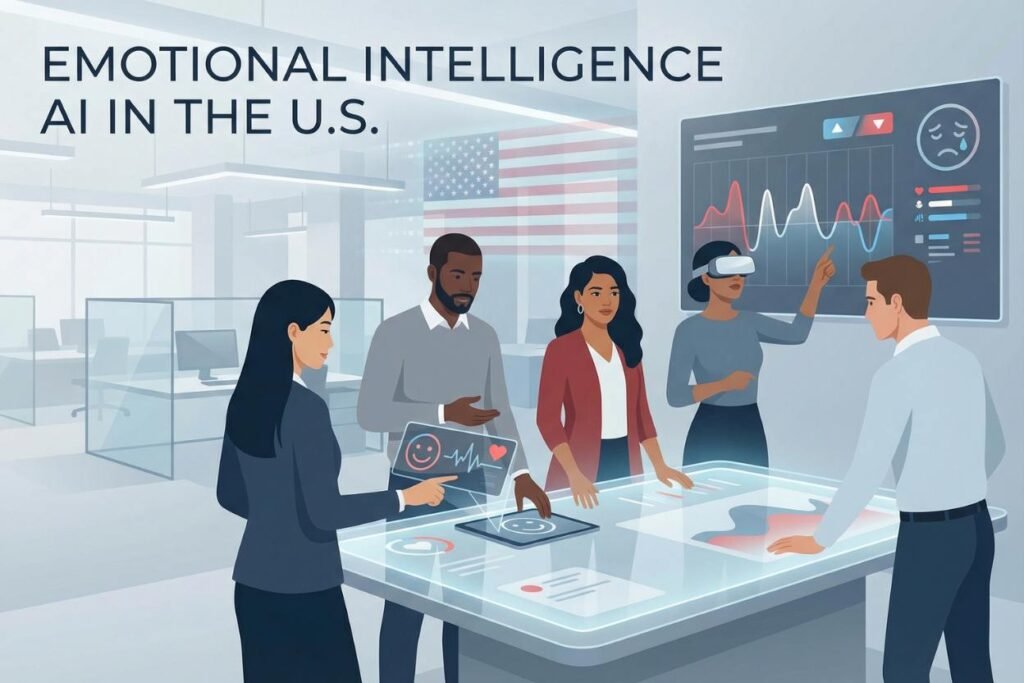

Emotional AI is reshaping how people in the United States interact with technology and each other by trying to detect, interpret and respond to human feelings. As emotional AI systems grow more advanced, they raise big questions about privacy, mental health, workplace performance, customer experience and social trust. Understanding how emotional AI works and where it succeeds or fails matters not just for tech professionals but for everyday Americans whose lives are increasingly shaped by smart systems that claim to understand emotion.
Emotional AI may help improve personalized learning, customer support, mental health tools and human machine interaction. Yet it also raises concerns over accuracy, manipulation and ethical boundaries tied to emotional intelligence AI and broader debates in AI ethics about responsibility, bias and data governance.
What emotional AI means in everyday life
Emotional AI refers to technology designed to recognize and interpret human emotional cues and then adjust responses to match or support users’ emotional states. These systems often rely on machine learning models that analyze facial expressions, tone of voice, text sentiment and other data to infer how a person feels. Some systems go further by generating responses that mimic empathy or encouragement.
This technology overlaps with emotional intelligence AI, which focuses on how machines simulate or apply emotional understanding in interactions. Emotional intelligence in humans is linked to better communication, teamwork and leadership. When scaled into AI systems it aims to make digital tools more responsive and adaptive to human affective states. According to growth projections the emotionally intelligent AI market in the United States could expand from about USD 0.87 billion in revenue in 2024 to more than USD 10.6 billion by 2034.
In practical terms emotionally responsive AI appears in apps that try to gauge user frustration, motivate learners, tailor recommendations, coach communication or adapt service interactions. Imagine a virtual agent in a call center that shifts tone when a customer sounds frustrated or a study app that remains calm and encouraging when a student struggles.
Emotional AI examples shaping American experiences
Emotionally aware interfaces are already embedded in tools many Americans use. In customer service, businesses deploy emotional AI to analyze call sentiment and route calls to agents with the right skills, improving satisfaction. Many marketers also leverage emotion detection to tailor messaging or optimize user journeys in shopping and entertainment platforms.
In mental health and wellness tech some apps use AI to offer reflection prompts, mood tracking and supportive dialogue. These systems are often marketed as emotional coaching assistants or stress support companions. While not a replacement for licensed therapy, they can provide some users an accessible outlet outside regular hours or when professional help is harder to reach.
A surprising trend involves conversational AI companions. Reports show a subset of users seek emotional support or connection from chatbots, sometimes reporting attachment or reliance on these tools. A recent safety report noted that a small portion of users show heightened emotional dependency on AI chatbots, though causal links to mental health outcomes remain unclear.
Another emotionally charged example comes from how younger Americans use AI in personal relationships. Surveys found that a notable share of Gen Z adults rely on AI to draft emotionally sensitive messages such as breakup texts, apology notes or conversation starters. Some say this builds confidence in communication, while skeptics worry about overreliance on automated emotional expression.
Why emotional AI matters for trust and interaction
One reason emotional AI draws attention is its potential to increase engagement and satisfaction. If a digital system can sense frustration, boredom or confusion it could adjust tone or suggestions in real time. This has clear benefits in educational tools, customer support and coaching apps.
Yet emotion driven AI faces technical barriers. Emotional expression varies across individuals, cultures and contexts. If models are not trained with diverse data, misinterpretation can occur. Asking a system to read emotion from facial cues or speech inflection assumes a one‑size‑fits‑all model of human expression, which research warns is not reliable without rigorous safeguards.
A deeper question is what it means for AI to appear emotionally intelligent. Machines do not feel emotions the way humans do. They simulate patterns based on data and statistical cues. Emotional AI systems may score high on standardized emotional reasoning tests yet still lack true empathy or awareness. Some studies found AI can outperform humans on certain emotional intelligence assessments, but experts stress this reflects pattern recognition rather than genuine emotional comprehension.
The ethical side of emotional AI
The rise of emotional AI brings ethical concerns into sharp focus, and these concerns tie directly into broader conversations about AI ethics regarding transparency, fairness and autonomy. If systems can gauge our emotional state they often rely on deeply personal data such as voice, facial expressions or typed messages.
Privacy advocates warn that such data, if mishandled or misused without clear consent, can undermine individual trust and dignity. These systems may interpret or store sensitive emotional information that users did not intend to share beyond the immediate session. Without transparent policies, collection could stray into surveillance.
Another ethical risk is manipulation. When technology tries to influence emotional states it may inadvertently exploit psychological vulnerabilities. This concern is not limited to commercial interactions but extends to political and social realms where emotional targeting could sway opinions or behavior without explicit awareness.
Bias and fairness issues also matter. Emotional AI can inherit cultural or demographic biases in training data, leading to skewed outcomes. For example a system that misreads emotions on certain faces may perform poorly for particular groups, deepening distrust and inequity.
Legal and social implications in the United States
American policymakers are increasingly alert to how AI systems interact with citizens’ rights and social outcomes. While there is no comprehensive federal regulation specific to emotional AI yet, states have begun scrutinizing AI use in mental health and emotional support roles. Illinois recently banned AI therapy without licensed professionals involved, citing potential harm and misinterpretation risks.
Consumer protections under laws like the Federal Trade Commission Act still apply to deceptive or unfair emotional AI practices, especially where data privacy and transparency are concerned. There is active discussion in policy circles about updating these frameworks to address emerging emotional AI risks more directly.
Social norms are also evolving. Users often assume emotional AI is more human than it really is, which can lead to misplaced trust or emotional dependency. This phenomenon echoes psychological insights known as the Tamagotchi effect where people form attachments to inanimate digital agents that simulate life‑like traits.
Balancing innovation with ethical safeguards
Despite concerns, emotional AI has promising applications. In healthcare settings, emotionally responsive systems may support patient engagement and wellness monitoring when paired with clinicians. In education, emotionally adaptive tutors could help identify frustration and adjust learning paths. In customer experience contexts AI can make automated service more responsive and humane.
The key is intentional design grounded in ethical AI practices that prioritize privacy, user control and clear communication about capabilities and limitations. Developers, businesses and regulators must work together to ensure emotional AI enhances user experience without crossing boundaries of autonomy or consent.
Public literacy in how emotional AI works is also vital. When individuals understand what the technology can and cannot do they can make informed decisions and avoid unrealistic expectations. Training and guidelines for developers and operators further support responsible deployment.
Questions we should ask about emotional AI
As emotional AI becomes more common in American technology landscapes it prompts deeper reflection. How much should machines participate in our emotional lives? When does convenience cross into emotional manipulation or dependency? Can we design systems that respect privacy and agency while offering genuine utility? These questions shape not just consumer experience but the future of AI governance and human technology relationships.
Emotional AI and emotional intelligence AI in US society
Emotional AI opens new frontiers in how technology interprets and responds to human feelings. Innovations in emotional intelligence AI have the potential to make digital interactions more adaptive, responsive and supportive. Yet these benefits come with significant ethical, privacy, social and legal implications that must be carefully managed as part of broader AI ethics discussions.
For Americans balancing innovation with individual rights and safeguards will determine whether emotional AI enhances daily life or creates new vulnerabilities. With thoughtful policy, transparent design and ongoing public engagement emotional AI can contribute meaningful value without undermining trust or autonomy.