

Machine learning has transformed from an academic curiosity into technology that powers everyday applications. Your phone’s face recognition, Netflix recommendations, spam filters, and voice assistants all rely on machine learning models working behind the scenes.
Yet for most people, machine learning remains mysterious. What exactly is a model? How does it learn patterns from data? Why does everyone say you need one when a simple calculator or spreadsheet formula might seem sufficient?
A machine learning model is fundamentally a mathematical function that learns patterns from data to make predictions or decisions without being explicitly programmed for every scenario. Unlike traditional software where you write specific rules for every situation, a model discovers rules on its own by studying examples.
Think about how you learned to recognize dogs as a child. Nobody gave you a rulebook listing precise measurements for ears, tails, and fur patterns. You saw many examples of dogs and gradually learned what makes a dog a dog. Machine learning models learn the same way, extracting patterns from data rather than following pre-programmed instructions.
This complete guide explains what machine learning models are from the ground up. We’ll cover the concept of function approximation, how models learn from data, the optimization process that makes learning possible, different types of problems models solve, and practical examples with actual code you can run.
Whether you’re considering a career in AI, evaluating machine learning solutions for your business, or simply curious about the technology reshaping our world, understanding models gives you the foundation for everything else. Let’s start with the absolute basics.
Understanding models as mathematical functions
At its core, a machine learning model is a function that takes inputs and produces outputs. If you remember basic math, a function is just a rule that transforms inputs into outputs. The function f(x) equals 2x takes any number x and doubles it.
Machine learning models work the same way but with more complexity. Instead of simple doubling, they perform sophisticated calculations that transform input data into predictions. A house price model takes features like square footage and number of bedrooms as inputs and outputs a predicted price.
The mathematical representation looks like this: y equals f(x) where x represents your input features, y represents the output prediction, and f is the model function doing the transformation.
What makes machine learning special is that you don’t manually write the function f. You provide examples of inputs paired with correct outputs, and the learning algorithm figures out what function best maps inputs to outputs.
This process is called function approximation. Your model is approximating an unknown function that relates inputs to outputs. You don’t know the exact relationship between house features and prices. The model learns an approximation by studying many examples.
The approximation will never be perfect because real world relationships are complex and noisy. But a good model gets close enough to be useful. Predicting house prices within 10 percent is valuable even if you can’t predict them exactly.
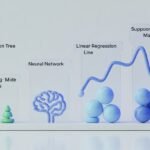
Different model types use different mathematical structures for their functions. Linear models use straight lines or planes. Decision trees use hierarchical rules. Neural networks use layers of connected neurons. But they all share this basic concept of learning a function from data.
The parameters or weights within your model are the values that define your specific function. Training adjusts these parameters until the function produces good predictions. A linear model might learn that each square foot adds 150 dollars to the price. That 150 is a parameter the model learned.
Simple example with actual math: suppose you want to predict test scores based on hours studied. Your model might learn the function: score equals 50 plus 10 times hours. The 50 and 10 are parameters. Given 3 hours of study, the model predicts 50 plus 10 times 3 equals 80 points.
Training found those specific parameter values by trying different numbers and seeing which ones made the best predictions on training data. This learning process is what we’ll explore next.
How models learn patterns from data
Understanding data in machine learning is essential because data is what models learn from. Every machine learning project starts with collecting examples that show the relationship you want the model to learn.
Your training data consists of many examples, each with input features and the corresponding correct output. For house prices, each example is one house with its features and actual sale price. For spam detection, each example is one email with its content and the label spam or not spam.
The model studies these examples looking for patterns. What combinations of features tend to produce what outputs? In the house price example, it might notice that larger square footage correlates with higher prices. More bedrooms also increase price. Older houses tend to cost less.
These aren’t rules you programmed. The model discovered them by analyzing the data. It identified statistical relationships between inputs and outputs that generalize beyond the specific training examples.
The learning process involves three key components. First, you need a model architecture that defines the mathematical structure. Second, you need a way to measure how well the model performs. Third, you need an optimization algorithm that improves performance.
Let’s see how this works with a concrete example. Suppose you’re predicting whether students pass or fail based on hours studied. Your training data has 100 students with their study hours and pass/fail outcomes.
Your model architecture might be logistic regression, which calculates a probability between 0 and 1. If the probability exceeds 0.5, predict pass. Otherwise predict fail.
Initially, the model makes random predictions because its parameters are set randomly. Maybe it predicts pass for everyone or fail for everyone. Its performance is terrible.
The model needs feedback about how wrong it is. This is where loss functions come in, measuring the gap between predictions and reality. High loss means bad predictions. Low loss means good predictions.
The optimization algorithm adjusts parameters to reduce loss. It tries different parameter values, sees if loss decreases, and keeps making adjustments. Over many iterations, loss decreases and predictions improve.
Eventually the model converges on parameter values that work well. It learned a function that maps study hours to passing probability. Now you can give it study hours for a new student it never saw, and it makes a reasonable prediction.
The model didn’t memorize the training data. It extracted generalizable patterns that apply to new examples. A student who studied 5 hours might not be in the training data, but the model can still predict their likelihood of passing.
This generalization ability separates machine learning from simple lookup tables. The model learns underlying relationships rather than just storing examples.
The role of loss functions in measuring error
Loss functions in machine learning quantify how wrong your model’s predictions are. Without a loss function, the model has no way to know if it’s improving or getting worse.
Think of loss as a score measuring prediction quality. Lower loss means better predictions. Higher loss means worse predictions. The goal of training is minimizing this loss value.
Different problems need different loss functions based on what you’re predicting. Mean squared error works for regression problems where you’re predicting numbers. It calculates the average of squared differences between predictions and actual values.
Let me show you MSE with actual numbers. Your model predicts house prices of 200k, 250k, and 300k. The actual prices were 210k, 240k, and 320k. The errors are negative 10k, 10k, and negative 20k.
Square those errors: 100 million, 100 million, and 400 million. Average them: 200 million. That’s your mean squared error. Your model’s predictions are off by an average squared error of 200 million.
Why square the errors? First, squaring makes all errors positive so positive and negative errors don’t cancel out. Second, it heavily penalizes large errors. An error of 20k contributes four times more to the loss than an error of 10k.
Mean absolute error is an alternative that just averages the absolute values of errors without squaring. Using the same example, the absolute errors are 10k, 10k, and 20k. Average them for an MAE of 13,333 dollars.
MAE is easier to interpret because it’s in the same units as your predictions. An MAE of 13k means your model is off by about 13k on average. But MSE has mathematical properties that make optimization easier.
For classification problems where you’re predicting categories, binary cross entropy is the standard loss function. It measures how far predicted probabilities are from the correct classes.
If your spam filter predicts 0.9 probability an email is spam and it actually is spam, that’s good. Low loss. If it predicts 0.1 probability of spam but the email is spam, that’s bad. High loss.
Cross entropy strongly penalizes confident wrong predictions. Being 90 percent confident in the wrong answer is much worse than being uncertain. This encourages models to be appropriately confident.
The loss function creates a landscape your model navigates during training. Parameter combinations that produce good predictions sit in valleys with low loss. Bad parameter combinations sit on hills with high loss. Training is the process of walking downhill.
Gradient descent and the optimization process
Gradient descent explained simply reveals how models actually improve their predictions through iterative optimization. Understanding this process shows you the mechanism behind machine learning.
Imagine standing on a mountainside in thick fog. You want to reach the valley at the bottom but can’t see where it is. You can only feel the slope beneath your feet. You take a step in whichever direction goes downhill most steeply. Then you check the slope again and take another step downhill. Eventually you reach a low point.
That’s exactly how gradient descent works. The mountain represents your loss function. Your position on the mountain corresponds to your current parameter values. The height at that position is your loss value. Walking downhill means adjusting parameters to reduce loss.
The gradient is the mathematical term for the slope or direction of steepest descent. At any point in parameter space, the gradient tells you which direction increases loss most rapidly. You move in the opposite direction to decrease loss.
Let me walk you through gradient descent with actual numbers so you see exactly how it works. Suppose you have a simple function y equals x squared. This creates a U shaped curve with its minimum at x equals 0 where y equals 0.
Your model starts at x equals 5, giving y equals 25. The slope at this point is 2 times x equals 10. This positive slope means the function increases as you move right. To go downhill, move left by decreasing x.
You set a learning rate of 0.1 controlling your step size. The update rule is: new x equals old x minus learning rate times slope. Starting from x equals 5 with slope 10: new x equals 5 minus 0.1 times 10 equals 4.
Now you’re at x equals 4 where the slope is 8. Update again: 4 minus 0.1 times 8 equals 3.2. You moved from 5 to 4 to 3.2, getting closer to the minimum at 0.
The slope decreases as you approach the minimum, so your steps get smaller. At x equals 3.2, slope equals 6.4, giving next x equals 2.56. At x equals 2.56, slope equals 5.12, giving next x equals 2.05.
Continue this process and x converges toward 0, the true minimum. You’re walking downhill following the gradient until you can’t go lower.
import numpy as np

def function(x):
    return x ** 2

def gradient(x):
    return 2 * x

x = 5.0
learning_rate = 0.1

print("Gradient descent in action:")
for step in range(15):
    grad = gradient(x)
    x = x - learning_rate * grad
    print(f"Step {step + 1}: x = {x:.4f}, f(x) = {function(x):.4f}, gradient = {grad:.4f}")
This code demonstrates gradient descent finding the minimum of x squared. Each iteration moves closer to x equals 0 where the function reaches its lowest value.
In real machine learning with many parameters, the same process applies but in high dimensional space. Instead of one x value, you have thousands or millions of parameters. The gradient becomes a vector pointing uphill in that high dimensional space. You move downhill by adjusting all parameters simultaneously.
The learning rate is crucial. Too small and training takes forever. Too large and you overshoot the minimum, potentially bouncing around or diverging completely. Finding the right learning rate requires experimentation.
Modern optimization algorithms like Adam and RMSprop improve on basic gradient descent by adapting learning rates automatically and using momentum to speed convergence. But the fundamental principle remains the same: follow the gradient downhill to minimize loss.
Every time you train a machine learning model, gradient descent or a variant runs behind the scenes. It’s the engine that powers learning, iteratively adjusting parameters until predictions improve.
Understanding gradient descent demystifies how models learn. There’s no magic. Just calculus and optimization, taking small steps toward better parameter values guided by the loss function gradient.
Building your first practical machine learning model
How to build your first machine learning model in Python transforms theoretical understanding into practical skills. Reading about models is valuable, but building one yourself cements the concepts.
Let’s create a complete working model from scratch. We’ll predict house prices using features like square footage, number of bedrooms, and age. This example demonstrates the entire machine learning workflow you’ll use in every project.
First you need Python and essential libraries installed. Pandas handles data, numpy provides numerical operations, and scikit-learn offers machine learning algorithms. Install them with pip install pandas numpy scikit-learn.
We’ll generate synthetic training data so you can follow along without external files. In real projects you’d load data from CSV files or databases.
import numpy as np
import pandas as pd
from sklearn.model_selection import train_test_split
from sklearn.linear_model import LinearRegression
from sklearn.metrics import mean_squared_error, mean_absolute_error

# Generate sample house data
np.random.seed(42)
n_houses = 200

square_feet = np.random.randint(1000, 4000, n_houses)
bedrooms = np.random.randint(2, 6, n_houses)
age = np.random.randint(0, 50, n_houses)

# Calculate prices with some randomness
base_price = 100000
price = base_price + (square_feet * 100) + (bedrooms * 15000) - (age * 800)
price = price + np.random.randint(-30000, 30000, n_houses)

# Create DataFrame
data = pd.DataFrame({
    'square_feet': square_feet,
    'bedrooms': bedrooms,
    'age': age,
    'price': price
})

print("First few houses:")
print(data.head())
print(f"\nDataset contains {len(data)} houses")
This creates 200 houses with realistic price relationships. Larger houses cost more. More bedrooms increase price. Older houses cost less. Random variation simulates real market noise.
Next separate features from the target and split into training and testing sets. The model learns from training data and we evaluate its performance on testing data it hasn’t seen.
# Separate features and target
X = data[['square_feet', 'bedrooms', 'age']]
y = data['price']

# Split 80% training, 20% testing
X_train, X_test, y_train, y_test = train_test_split(
    X, y, test_size=0.2, random_state=42
)

print(f"\nTraining examples: {len(X_train)}")
print(f"Testing examples: {len(X_test)}")
Now create and train the model. We’ll use linear regression which learns linear relationships between features and the target. Training happens in one line with the fit method.
# Create and train model
model = LinearRegression()
model.fit(X_train, y_train)

print("\nModel trained successfully!")
print(f"Coefficients: {model.coef_}")
print(f"Intercept: {model.intercept_:.2f}")
The coefficients show how much each feature contributes to the price prediction. A coefficient of 100 for square_feet means each additional square foot adds about 100 dollars to the predicted price.
Make predictions on the test set to see how well the model works on new data.
# Predict prices for test set
y_pred = model.predict(X_test)

# Compare first 5 predictions to actual prices
print("\nSample predictions:")
for i in range(5):
    print(f"Actual: ${y_test.iloc[i]:,.0f} | Predicted: ${y_pred[i]:,.0f}")
Calculate performance metrics to quantify model accuracy. Mean absolute error tells you the typical prediction error in dollars.
# Calculate metrics
mae = mean_absolute_error(y_test, y_pred)
mse = mean_squared_error(y_test, y_pred)
rmse = np.sqrt(mse)

print(f"\nModel Performance:")
print(f"Mean Absolute Error: ${mae:,.2f}")
print(f"Root Mean Squared Error: ${rmse:,.2f}")
Now use your trained model to predict prices for brand new houses.
# Predict for new houses
new_houses = pd.DataFrame({
    'square_feet': [2000, 2500, 3000],
    'bedrooms': [3, 4, 4],
    'age': [5, 10, 20]
})

new_predictions = model.predict(new_houses)
print("\nPredictions for new houses:")
for i, price in enumerate(new_predictions):
    print(f"House {i+1}: ${price:,.2f}")
You’ve now built a complete machine learning pipeline. Load data, split it properly, train a model, evaluate performance, and make predictions on new examples. Every machine learning project follows this same basic structure.
The model isn’t perfect. Some predictions are off by tens of thousands of dollars. But it learned useful patterns from the training data and can make reasonable predictions for houses it never saw before.
Real projects involve messier data, more features, and iterative improvement. But the core workflow remains identical. This foundation lets you tackle more complex problems with confidence.
Different types of machine learning models
Machine learning model types fall into distinct categories based on what you’re trying to predict. Choosing the right type for your problem is crucial because using regression when you need classification wastes time and produces unusable results.
Understanding these categories helps you select appropriate algorithms and avoid common mistakes. Let’s explore the three main types and when to use each one.
Regression models predict continuous numerical values. Use regression when your target is a number that can take any value within a range. House prices, stock prices, temperatures, sales figures, distances, ages, and weights all require regression.
The key characteristic is that your output lies on a continuous scale. Predicting a house will cost 275,342 dollars or tomorrow’s temperature will be 68.7 degrees requires regression. You’re not choosing from predefined categories. You’re estimating a quantity.
Linear regression assumes straight line relationships between features and targets. Despite its simplicity, it works surprisingly well for many problems and should be your starting point for regression tasks.
Decision tree regression handles non-linear relationships by splitting data based on feature values. Random forest regression combines many trees for better accuracy and reduced overfitting. Neural networks can learn very complex patterns but need substantial data.
from sklearn.linear_model import LinearRegression
from sklearn.ensemble import RandomForestRegressor
from sklearn.tree import DecisionTreeRegressor

# Sample regression data
X_reg = np.array([[1], [2], [3], [4], [5]])
y_reg = np.array([2.1, 4.2, 5.8, 8.1, 10.3])

# Try different regression models
linear = LinearRegression()
linear.fit(X_reg, y_reg)

tree = DecisionTreeRegressor(max_depth=3)
tree.fit(X_reg, y_reg)

forest = RandomForestRegressor(n_estimators=10)
forest.fit(X_reg, y_reg)

print(f"Linear prediction for x=6: {linear.predict([[6]])[0]:.2f}")
print(f"Tree prediction for x=6: {tree.predict([[6]])[0]:.2f}")
print(f"Forest prediction for x=6: {forest.predict([[6]])[0]:.2f}")
Classification models predict categories or classes. Use classification when your target is a discrete label from a predefined set. Spam or legitimate, cat or dog, fraudulent or valid, disease present or absent all need classification.
You’re not predicting how much or how many. You’re predicting which type or which group. The output must be one of your predefined categories.
Binary classification handles two classes like yes/no or positive/negative. Multi-class classification handles three or more classes like predicting animal species or customer segments.
Logistic regression is the standard algorithm for binary classification despite its confusing name. It calculates probabilities for each class and assigns instances to the most likely class.
Decision trees work for classification just like regression but predict class labels instead of numbers. Random forests improve accuracy by combining many trees.
Support vector machines find optimal boundaries separating classes. Naive Bayes works well for text classification. Neural networks handle very complex classification problems when you have enough training data.
from sklearn.linear_model import LogisticRegression
from sklearn.ensemble import RandomForestClassifier
from sklearn.datasets import make_classification

# Generate classification data
X_clf, y_clf = make_classification(
    n_samples=100, n_features=4, n_classes=2, random_state=42
)

# Train classifiers
log_reg = LogisticRegression()
log_reg.fit(X_clf, y_clf)

rf_clf = RandomForestClassifier(n_estimators=10)
rf_clf.fit(X_clf, y_clf)

# Predict class for new data
new_sample = X_clf[0:1]
print(f"Logistic regression prediction: {log_reg.predict(new_sample)[0]}")
print(f"Random forest prediction: {rf_clf.predict(new_sample)[0]}")
print(f"Prediction probabilities: {log_reg.predict_proba(new_sample)[0]}")
Clustering models discover natural groupings in data without predefined labels. Use clustering when you want to find patterns or segments but don’t have labels telling you what groups exist.
Unlike regression and classification where you have targets to predict, clustering is unsupervised learning. You give the algorithm unlabeled data and it discovers structure on its own.
Customer segmentation exemplifies clustering. You have behavioral data but no predefined customer types. Clustering reveals groups of similar customers you can target with different strategies.
K-means is the most popular clustering algorithm. You specify the number of clusters and it assigns each data point to the nearest cluster center. It’s fast and works well when clusters are roughly spherical.
Hierarchical clustering builds a tree of clusters without requiring you to specify the number upfront. DBSCAN finds arbitrarily shaped clusters and identifies outliers automatically.
from sklearn.cluster import KMeans
import matplotlib.pyplot as plt

# Generate data with natural clusters
from sklearn.datasets import make_blobs
X_cluster, _ = make_blobs(n_samples=150, centers=3, random_state=42)

# Perform k-means clustering
kmeans = KMeans(n_clusters=3, random_state=42)
labels = kmeans.fit_predict(X_cluster)

print(f"Cluster assignments for first 10 points: {labels[:10]}")
print(f"Cluster centers:\n{kmeans.cluster_centers_}")
Choosing between model types is straightforward once you understand what you’re predicting. Continuous numbers need regression. Categories need classification. Discovering patterns without labels needs clustering.
Within each type, start with simpler algorithms. Linear regression, logistic regression, and k-means cover most basic use cases. Move to more complex algorithms only when simple ones don’t perform well enough.
Key concepts every beginner should understand
Beyond the basic model types, several fundamental concepts apply across all machine learning. Understanding these ideas helps you avoid common pitfalls and build better models.
Overfitting versus underfitting represents one of the central challenges in machine learning. Your model needs to learn patterns that generalize to new data, not just memorize training examples.
Overfitting happens when a model learns the training data too well, including its noise and random fluctuations. The model performs excellently on training data but poorly on new examples. It memorized specific instances rather than learning general patterns.
Imagine studying for a test by memorizing all practice problems word for word. You’d ace those exact problems but struggle with slightly different questions. That’s overfitting.
Underfitting is the opposite problem. The model is too simple to capture meaningful patterns in the data. It performs poorly on both training and testing data because it never learned the underlying relationships.
This is like studying too briefly or using the wrong study materials. You didn’t learn enough to perform well even on familiar material.
The sweet spot is a model complex enough to capture real patterns but not so complex it memorizes noise. Finding this balance is crucial for building useful models.
from sklearn.preprocessing import PolynomialFeatures
from sklearn.pipeline import make_pipeline

# Generate data with noise
X_fit = np.linspace(0, 10, 50).reshape(-1, 1)
y_fit = np.sin(X_fit).ravel() + np.random.normal(0, 0.2, X_fit.shape[0])

# Underfit model (too simple)
underfit = LinearRegression()
underfit.fit(X_fit, y_fit)

# Good fit model
goodfit = make_pipeline(PolynomialFeatures(3), LinearRegression())
goodfit.fit(X_fit, y_fit)

# Overfit model (too complex)
overfit = make_pipeline(PolynomialFeatures(15), LinearRegression())
overfit.fit(X_fit, y_fit)

print("Models demonstrate underfitting, good fitting, and overfitting")
Training, validation, and test sets help you detect overfitting and evaluate model performance properly. Never evaluate your model on the same data it trained on. That tells you nothing about how it will perform on new examples.
Split your data into at least two sets. Train on one set and test on the other. The training set teaches the model. The test set evaluates how well it learned.
A three way split is even better. Training data trains the model. Validation data helps you tune settings and compare different models. Test data provides the final performance evaluation on completely unseen data.
Common split ratios are 70/15/15 or 60/20/20 for training/validation/test. With smaller datasets you might use 80/20 for just training and test.
Cross validation provides more robust performance estimates by training and evaluating multiple times on different data splits. Five fold cross validation splits data into five parts, trains on four parts and tests on one part, then repeats five times using each part as the test set once.
Feature engineering creates new features from existing ones to help your model learn better. Sometimes raw features don’t directly capture what matters for predictions. Transforming or combining them creates more useful inputs.
If you’re predicting house prices and have length and width, multiplying them gives you area which is probably more predictive than the individual dimensions. That’s feature engineering.
You might create ratio features, polynomial features, interaction terms between variables, or domain-specific calculations. Good feature engineering often improves performance more than switching to a fancier algorithm.
Scaling and normalization put features on similar ranges so no single feature dominates learning. If one feature ranges from 0 to 1000000 and another from 0 to 1, the large numbers can overwhelm the model’s learning process.
Standardization transforms features to have mean zero and standard deviation one. Min-max scaling squashes features into a range like 0 to 1. Both prevent features with large values from dominating smaller ones.
from sklearn.preprocessing import StandardScaler, MinMaxScaler

# Sample data with different scales
data_scale = np.array([[1, 1000], [2, 2000], [3, 3000], [4, 4000]])

# Standardize features
scaler_standard = StandardScaler()
standardized = scaler_standard.fit_transform(data_scale)

# Min-max scale features
scaler_minmax = MinMaxScaler()
minmax_scaled = scaler_minmax.fit_transform(data_scale)

print("Original data:\n", data_scale[:3])
print("\nStandardized:\n", standardized[:3])
print("\nMin-max scaled:\n", minmax_scaled[:3])
Bias and variance trade-off relates to overfitting and underfitting. Bias is error from overly simple assumptions. High bias models underfit because they can’t capture data complexity.
Variance is error from sensitivity to small fluctuations in training data. High variance models overfit because they learn noise as if it were signal.
You want low bias and low variance, but there’s usually a trade-off. Simpler models have high bias but low variance. Complex models have low bias but high variance. Finding the right complexity balances these errors.
Model evaluation metrics help you understand performance beyond simple accuracy. For regression, mean absolute error and root mean squared error quantify prediction errors in the original units.
For classification, accuracy tells you the percentage of correct predictions. But accuracy can be misleading with imbalanced classes. If 95 percent of emails are legitimate, predicting everything as legitimate gives 95 percent accuracy but catches zero spam.
Precision measures what fraction of positive predictions were actually positive. Recall measures what fraction of actual positives you caught. F1 score balances precision and recall.
Confusion matrices show exactly where your classifier makes mistakes, breaking down true positives, false positives, true negatives, and false negatives.
from sklearn.metrics import classification_report, confusion_matrix

# Sample predictions and actual labels
y_true_sample = np.array([0, 1, 0, 1, 1, 0, 1, 0, 1, 1])
y_pred_sample = np.array([0, 1, 0, 1, 0, 1, 1, 0, 1, 1])

print("Classification Report:")
print(classification_report(y_true_sample, y_pred_sample))

print("\nConfusion Matrix:")
print(confusion_matrix(y_true_sample, y_pred_sample))
Understanding these concepts helps you build better models and avoid common mistakes. You’ll know when your model is overfitting, how to evaluate it properly, and what metrics matter for your specific problem.
Real world applications and practical considerations
Machine learning models solve countless real world problems across every industry. Understanding practical applications shows you where these techniques create value and how to think about applying them yourself.
Predictive analytics uses historical data to forecast future outcomes. Businesses predict customer churn, sales volumes, equipment failures, and demand patterns. These predictions drive better decisions about inventory, staffing, maintenance, and resource allocation.
A retail company might predict which customers are likely to stop buying and target them with retention offers. A manufacturer predicts when machines will break down and schedules maintenance before failures occur. Airlines predict no-show rates to optimize overbooking strategies.
The models learn patterns from past data that indicate future behavior. Someone who hasn’t made a purchase in six months and stopped opening emails is probably churning. Equipment showing certain vibration patterns is likely approaching failure.
Recommendation systems suggest products, content, or connections users might like. Netflix recommends shows, Amazon suggests products, Spotify creates playlists, and LinkedIn suggests connections. These systems analyze your behavior and preferences to personalize suggestions.
Collaborative filtering finds users similar to you and recommends things they liked that you haven’t tried yet. Content-based filtering recommends items similar to ones you previously enjoyed. Hybrid systems combine both approaches.
These recommendations drive significant business value. A large portion of Netflix viewing and Amazon purchases come from algorithmic suggestions rather than direct searches.
Image recognition identifies objects, faces, text, and scenes in photos and videos. Your phone unlocks with face recognition. Google Photos organizes pictures by detecting people, places, and things. Medical imaging systems help diagnose diseases from X-rays and scans.
Convolutional neural networks excel at image tasks by learning hierarchical visual features. Early layers detect edges and textures. Middle layers recognize shapes and patterns. Final layers identify complete objects.
Quality depends heavily on training data. Models trained on millions of diverse images generalize well. Models trained on limited or biased data make mistakes on images that differ from training examples.
Natural language processing enables machines to understand and generate human language. Chatbots answer customer questions. Translation apps convert between languages in real time. Sentiment analysis determines whether reviews are positive or negative.
Text classification categorizes documents, filters spam, and routes support tickets. Named entity recognition extracts people, organizations, and locations from text. Question answering systems retrieve specific information from documents.
Large language models trained on massive text corpora can perform many language tasks with minimal additional training. These models understand context, grammar, and semantics well enough for practical applications.
Fraud detection identifies suspicious transactions, claims, or activities. Banks flag potentially fraudulent credit card charges. Insurance companies detect fraudulent claims. Online platforms identify fake accounts and bot activity.
Models learn patterns of normal behavior and flag deviations. A credit card suddenly used in a different country for unusual purchases triggers alerts. Insurance claims with characteristics matching known fraud patterns get extra scrutiny.
The challenge is balancing false positives and false negatives. Too sensitive and you annoy customers with frequent false alarms. Too lenient and you miss actual fraud.
from sklearn.ensemble import IsolationForest

# Simulate transaction data
normal_transactions = np.random.normal(100, 20, 95)
fraudulent_transactions = np.random.normal(500, 50, 5)
transactions = np.concatenate([normal_transactions, fraudulent_transactions]).reshape(-1, 1)

# Train anomaly detection model
fraud_detector = IsolationForest(contamination=0.05, random_state=42)
fraud_detector.fit(transactions)

# Predict anomalies
predictions = fraud_detector.predict(transactions)
anomalies = np.where(predictions == -1)[0]

print(f"Detected {len(anomalies)} suspicious transactions")
print(f"Suspicious transaction indices: {anomalies}")
Time series forecasting predicts future values based on historical sequences. Weather forecasting, stock price prediction, energy demand forecasting, and sales projections all use time series models.
These models account for trends, seasonality, and other temporal patterns. Sales might trend upward over years, show weekly cycles, and spike during holidays. Good forecasts capture all these patterns.
Traditional statistical methods like ARIMA work for simpler patterns. Neural networks handle more complex temporal dependencies. The choice depends on your data characteristics and forecasting horizon.
Practical considerations affect whether models work in production. Computational requirements matter. A model that takes hours to make predictions won’t work for real time applications. Simple models often beat complex ones when deployment constraints matter.
Data quality determines model performance more than algorithm choice. Accurate, relevant, recent data beats sophisticated algorithms on poor data. Invest in data quality before obsessing over model tweaks.
Explainability matters for high stakes decisions. Linear models and decision trees show clear reasoning. Neural networks are black boxes. If you need to explain why a loan was denied or a patient diagnosed, choose interpretable models.
Maintenance and monitoring are ongoing requirements. Data distributions shift over time. Models trained on last year’s data might not work well on this year’s data. You need systems to detect performance degradation and retrain models periodically.
Ethical considerations include fairness, privacy, and unintended consequences. Models can perpetuate or amplify biases in training data. They can invade privacy by inferring sensitive information. They can be gamed or manipulated by adversaries.
Building responsible machine learning systems requires thinking beyond technical performance to broader impacts. Who is affected by your model’s decisions? What could go wrong? How do you ensure fairness and accountability?
Real world machine learning combines technical skills with domain knowledge, business understanding, and ethical awareness. The best practitioners understand both how models work and how to apply them responsibly to create value.
Conclusion
Machine learning models are mathematical functions that learn patterns from data to make predictions without explicit programming for every scenario. Understanding this fundamental concept unlocks the ability to work with AI effectively, whether you’re building systems yourself or evaluating solutions for your organization.
We’ve covered the essential foundations that every machine learning practitioner needs. Models approximate functions by learning from examples rather than following pre-programmed rules. They use loss functions to measure prediction quality and gradient descent to optimize parameters through iterative improvement.
The three main model types serve different purposes. Regression predicts continuous numbers like prices or temperatures. Classification assigns examples to categories like spam or legitimate. Clustering discovers natural groupings in unlabeled data. Choosing the right type for your problem is the first critical decision in any project.
Data quality and preparation matter more than algorithm sophistication. Clean, relevant features enable even simple models to perform well. Poor data dooms even the most advanced algorithms. Spend time understanding your data, engineering useful features, and ensuring proper train/test splits before worrying about model complexity.
Key concepts like overfitting, cross validation, and proper evaluation metrics separate successful projects from failed ones. Models must generalize to new examples, not just memorize training data. Evaluating on unseen test data reveals true performance. Appropriate metrics measure what actually matters for your application.
Real world applications span every industry and domain. Predictive analytics forecasts future outcomes. Recommendation systems personalize suggestions. Image recognition identifies visual content. Natural language processing understands text and speech. Fraud detection catches suspicious activity. These practical applications demonstrate machine learning’s transformative power.
Building effective systems requires balancing technical performance with practical constraints. Computational requirements, explainability needs, maintenance costs, and ethical considerations all influence design choices. The best solution isn’t always the most technically sophisticated. It’s the one that works reliably in production while meeting real world constraints.
Machine learning isn’t magic or impossibly complex. It’s applied mathematics and statistics that becomes intuitive with hands-on practice. The models you build won’t be perfect. No model is. But they’ll be useful, solving real problems and creating tangible value.
The learning journey doesn’t end with understanding what models are and how they work. Practical experience building projects cements these concepts and develops the intuition that separates beginners from practitioners. Theory provides the foundation but practice builds expertise.
Start simple and iterate. Your first models should use straightforward algorithms on clean datasets. Linear regression and logistic regression teach core concepts without overwhelming complexity. Build working systems before attempting cutting edge techniques.
Every expert started exactly where you are now. They learned the fundamentals, built projects, made mistakes, debugged problems, and gradually developed mastery. The path is open to anyone willing to invest the time and effort.
Machine learning transforms industries, creates new possibilities, and shapes the technology driving our future. Understanding models gives you the foundation to participate in this transformation rather than simply watching it happen.
The concepts you’ve learned here apply whether you’re building recommendation systems, analyzing medical data, optimizing business processes, or creating entirely new applications. The specifics change but the fundamental principles remain constant.
Your next step is translating understanding into action. Theory without practice remains abstract. Building actual models, even simple ones, transforms conceptual knowledge into practical skills. Ready to get your hands dirty with real code and data? Check out understanding data in machine learning to learn how to properly prepare and structure data for training your first models. That practical foundation will serve you throughout your machine learning journey.