
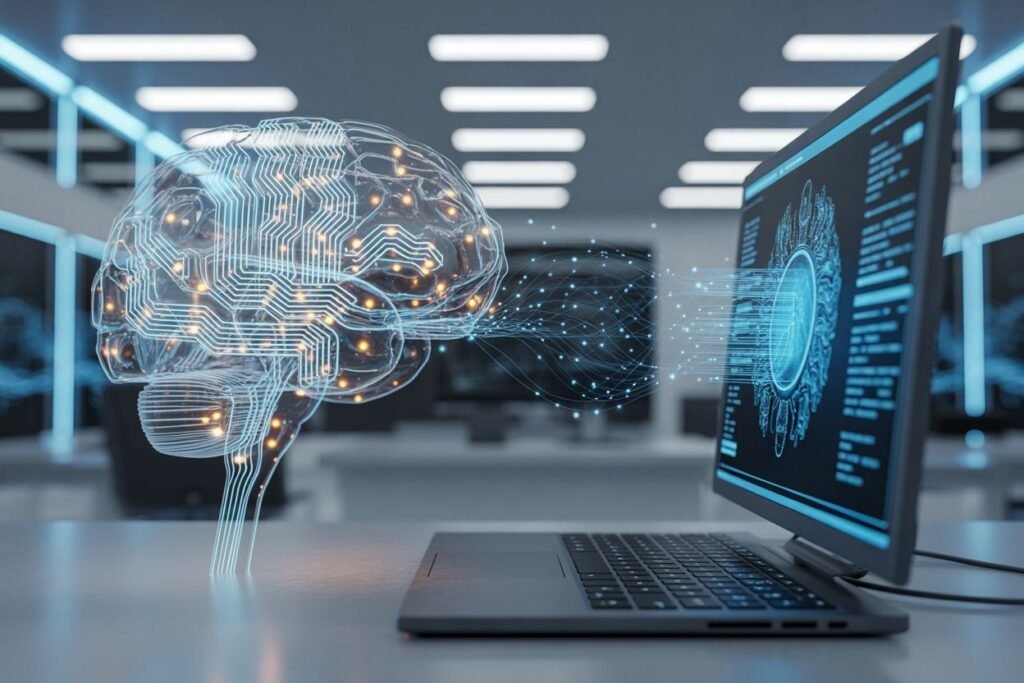

You’ve probably heard the term machine learning thrown around a lot lately. It powers Netflix recommendations, helps doctors diagnose diseases, and even decides which emails land in your spam folder. But what exactly is machine learning, and how do computers actually learn things without someone programming every single step?
If you’re curious about how AI works behind the scenes, understanding machine learning is your starting point. It’s one of the core concepts that makes artificial intelligence so powerful today. Let me break it down in the simplest way possible.
The basic idea behind machine learning
Traditional computer programs work like following a recipe. A programmer writes specific instructions, and the computer follows them exactly. If you want the computer to recognize a cat in a photo, you’d have to write rules like “if it has pointy ears and whiskers, it might be a cat.” The problem is that cats come in all shapes, sizes, and colors. Writing rules for every possible variation would be nearly impossible.
Machine learning flips this approach on its head. Instead of programming rules, you feed the computer thousands of cat photos and let it figure out the patterns on its own. The computer learns what makes a cat a cat by studying examples, much like how you learned to recognize animals as a child.
How does machine learning actually work?
Think of machine learning like teaching a kid to ride a bike. You don’t hand them a manual with physics equations about balance and momentum. Instead, they get on the bike, fall a few times, adjust, and eventually figure it out through trial and error.
Machine learning systems work the same way. They make predictions, check if they’re right or wrong, and adjust their approach based on the results. This process happens thousands or millions of times until the system gets really good at the task.
The key ingredient is data. Lots and lots of data. The more examples a machine learning system sees, the better it becomes at recognizing patterns and making accurate predictions.
Three main types of machine learning
Machine learning isn’t just one technique. There are different approaches depending on what you’re trying to achieve.
Supervised learning
This is like learning with a teacher who gives you the answers. You show the computer labeled examples, like photos marked as “cat” or “dog,” and it learns to classify new images on its own.
Supervised learning powers spam filters, fraud detection systems, and medical diagnosis tools. It’s the most common type of machine learning you’ll encounter in everyday applications.
Unsupervised learning
Here, the computer explores data without any labels or guidance. It looks for hidden patterns and groups similar things together on its own.
Imagine dumping a box of mixed buttons on a table and asking someone to organize them. They might group by color, size, or shape without you telling them how. That’s essentially what unsupervised learning does with data.
Companies use this to segment customers, recommend products, or detect unusual patterns that might indicate problems.
Reinforcement learning
This approach learns through rewards and punishments, like training a dog with treats. The system tries different actions, gets feedback on whether those actions were good or bad, and learns to maximize rewards over time.
Reinforcement learning taught computers to beat world champions at chess and Go. It also helps robots learn to walk and powers self-driving car technology.
Real examples of machine learning in action
Machine learning isn’t just theoretical. You interact with it constantly, often without realizing it.
When you type a search query into Google, machine learning algorithms figure out which results are most relevant to you. When Spotify creates your Discover Weekly playlist, that’s machine learning analyzing your listening habits and finding songs you might enjoy.
Your phone’s face recognition system uses machine learning to identify you among billions of possible faces. Banks use it to spot fraudulent transactions by recognizing patterns that don’t match your normal spending behavior.
Even your email inbox relies on machine learning to filter out spam and organize your messages. These systems get smarter over time because they continuously learn from new data.
Why machine learning matters now more than ever
The explosion of machine learning in recent years isn’t random. Three things came together at the right time.
First, we have more data than ever before. Every click, purchase, and interaction online generates information that can train machine learning systems.
Second, computing power became incredibly cheap and accessible. Tasks that once required supercomputers can now run on your laptop or in the cloud.
Third, researchers developed better algorithms and techniques. Deep learning, a subset of machine learning inspired by the human brain, proved especially powerful for complex tasks like image and speech recognition.
These factors combined to make machine learning practical for solving real problems across every industry you can imagine.
The limitations you should know about
Machine learning is powerful but not magic. These systems are only as good as the data they learn from. If you train a system on biased or incomplete data, it will make biased or incomplete decisions.
Machine learning models also can’t explain their reasoning the way humans can. They might accurately predict something but can’t always tell you why they made that prediction. This “black box” problem becomes serious when these systems make important decisions about loans, hiring, or medical treatment.
These systems also need tons of data and computing power to work well. Small businesses or individuals often can’t compete with tech giants who have access to massive datasets and computing resources.
Getting started with machine learning yourself
You don’t need a computer science degree to start exploring machine learning. Plenty of free tools and platforms let you experiment with basic concepts.
Python has become the go-to programming language for machine learning, with libraries like scikit-learn making it accessible to beginners. Google Colab provides free cloud computing to run machine learning experiments without expensive hardware.
Start with simple projects like predicting house prices or classifying images. Online courses on platforms like Coursera and YouTube offer structured learning paths that take you from basics to advanced topics.
The key is getting your hands dirty with actual projects. Reading about machine learning is helpful, but building something yourself teaches you far more.
What comes next
Machine learning continues evolving at a breakneck pace. Models are getting more efficient, requiring less data and computing power to achieve better results. Techniques like transfer learning let you adapt existing models to new tasks without starting from scratch.
The field is also becoming more accessible. No-code platforms now let people build machine learning applications without writing a single line of code. This democratization means more people can use these tools to solve problems in their own domains.
Understanding machine learning gives you insight into how modern technology works and where it’s heading. Whether you want to build AI applications yourself or simply understand the tools shaping our world, grasping these fundamentals puts you ahead of the curve.
Want to dig deeper into how machine learning actually processes information? Check out our guide on neural networks explained simply to understand the brain-inspired technology powering today’s most advanced AI systems.Retry