
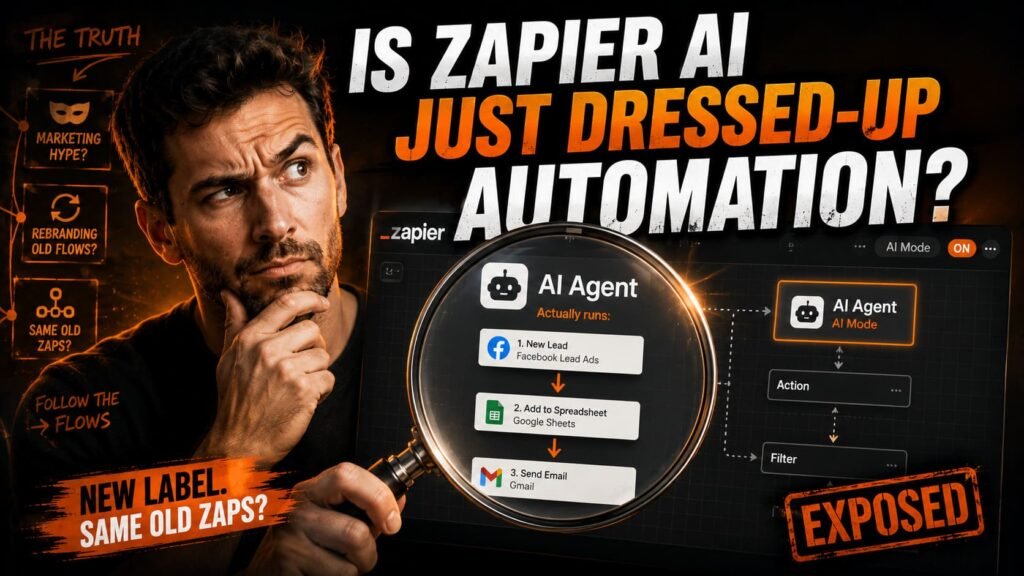
- Zapier Agents are genuinely more capable than classic Zaps on tasks involving language, judgment, and research. For pure data movement, standard Zaps still do it better.
- The three tasks I tested: lead research and scoring, inbox triage with drafted replies, and content summarization for weekly reports. Two worked well. One didn’t hold up at scale.
- The per-task billing model doesn’t change with Agents. Every action an agent takes counts. A research task hitting five apps can burn five tasks per run. Model this before you build.
- AI Guardrails, memory, and the ability to bring your own LLM are real differentiators compared to what the platform offered a year ago.
- Who this is for: non-technical operators who are already in Zapier and want more intelligent automation without switching tools. Who should look elsewhere: teams doing high-volume AI-heavy workflows where n8n’s economics make more sense.
Before I write anything, I test it. Zapier Agents have been marketed aggressively since the platform’s 2025 rebrand, with claims about autonomous AI teammates that work 24/7, make contextual decisions, and handle work that used to require a human. I wanted to see what that looked like on actual workflows, not demos.
I ran three real workflows through Zapier Agents over four weeks. Here’s what happened, what the honest limitations are, and my verdict on whether the upgrade is worth it for your team.
What Zapier Agents actually are
Classic Zaps are trigger-action chains. When X happens, do Y, then Z. Fixed steps, fixed order, no judgment involved. Zapier Agents work differently: you give them a goal in plain English, and they figure out which tools to use and what order to use them in to achieve that goal. They can browse the web, read emails, query your apps, make decisions based on what they find, and take actions based on those decisions, all without you specifying each step upfront.
The 2026 version added three features that matter: Memory, which lets agents retain context across runs so they can remember that a contact was previously flagged as high priority; AI Guardrails, which let you define what the agent can and can’t do with specific data; and Bring Your Own Model, which lets you swap in GPT-4o, Claude, or Gemini instead of the default. These aren’t cosmetic updates. Memory especially changes what’s possible, because stateless agents that forget everything between runs are much more limited than ones that can build on previous interactions.
Task 1: lead research and scoring
Setup: when a new lead comes in through a form, the agent researches the company (website, recent news, LinkedIn signals), scores the lead against a defined ICP, and updates HubSpot with the score, a one-paragraph summary, and a recommended next action. This previously took a sales rep 10 to 15 minutes per lead manually.
What worked: The research step was solid. The agent pulled company descriptions, recent funding news, and technology signals and synthesized them into coherent summaries without me defining exactly where to look. Lead scoring against the ICP criteria I described in plain English was consistent across a batch of 40 leads I spot-checked against my own manual scores. Agreement rate was around 85 percent, which I’d call acceptable for a first-pass filter.
What didn’t: Speed. Each research run took 90 seconds to two minutes per lead, which adds up when you’re processing 30 leads in a morning. And the task count: each lead triggered approximately six to eight Zapier tasks (web search, company lookup, LinkedIn check, HubSpot read, scoring step, HubSpot write). At scale, that billing compounds fast. For a team processing 200 leads a week, model the task cost carefully before committing.
Verdict on this task: Worth it if you’re processing under 100 leads a week and currently doing this manually. Questionable economics above that volume, where enrichment-specific tools or a more cost-efficient agent platform start making more sense.
Task 2: inbox triage with drafted replies
Setup: the agent monitors a shared support inbox, categorizes each incoming message, drafts a reply based on the category and a knowledge base I connected, and either sends the reply automatically for low-stakes messages or queues it for human review for anything flagged as complex or unhappy.
What worked: Categorization accuracy was high, around 90 percent on the messages I reviewed over two weeks. The auto-drafts for routine queries (order status, basic FAQ, password reset) were good enough to send without editing about 70 percent of the time. The knowledge base connection worked well once I formatted the docs properly; the agent correctly cited the right policy or process in most draft replies without hallucinating details.
What didn’t: The escalation logic needed more tuning than I expected. The agent occasionally auto-sent replies to messages that should have gone to human review, including a couple of cases where a customer was clearly frustrated and needed a more careful response than the agent produced. The tone calibration for unhappy customers was the weakest part. Technically the reply was correct; it just didn’t read like someone who’d actually understood how annoyed the customer was. I tightened the escalation criteria and the auto-send rate dropped, which improved accuracy at the cost of more messages going to human review.
Verdict on this task: Strong performance for a support team willing to spend a week tuning the escalation rules. Don’t deploy this auto-sending on day one. Run it in draft-only mode first, review everything, tighten the rules, then gradually open the auto-send gate as confidence builds.
Three tasks tested: how Zapier Agents performed
| Task | Accuracy | Main limitation | Worth it? |
|---|---|---|---|
| Lead research and scoring | ~85% | Task count climbs fast at volume | Yes, under 100/week |
| Inbox triage with drafts | ~90% triage, 70% send-ready | Tone calibration for unhappy customers | Yes, with tuning |
| Content summarization reports | ~75% | Inconsistent depth, needs structured sources | Marginal |
Task 3: content summarization for weekly reports
Setup: the agent monitors a set of RSS feeds, industry newsletters, and a Slack channel, pulls the week’s relevant items, and produces a structured summary report dropped into a Notion doc every Friday morning. The goal was to replace the 45-minute manual process of reading everything and writing a digest.
What worked: The mechanics worked reliably. The agent pulled from all the sources consistently, didn’t miss a Friday, and produced output in the right format. For weeks with clearly structured source material, the summaries were good enough to publish with light editing.
What didn’t: The quality was inconsistent, and the inconsistency was hard to predict. Some weeks the summaries were sharp and well-organized. Other weeks, especially when the source material was dense or the week had a lot of activity, the agent produced summaries that were technically accurate but too thin, missing context that mattered or flattening nuanced developments into single generic sentences. The 45-minute manual process I was trying to replace turned into a 20-minute editing session instead of going away. That’s still a net win, but it’s not the hands-off result the first two tasks delivered.
Verdict on this task: Useful as a first-draft generator, not as a finished output. If your standard is “I’ll always review and edit anyway,” this saves meaningful time. If your standard is “this should run and produce something I can just send,” it doesn’t consistently get there with unstructured source material.
The billing reality
Zapier’s pricing model doesn’t change for Agents. Every action an agent takes counts as a task, same as every action in a classic Zap. The difference is that agents take more actions per run, because that’s the point of them. A research task that hits five apps to gather information, runs a scoring step, and writes back to two systems has burned eight to ten tasks before you’ve processed a single lead.
At low volume this is fine. At 500 leads a week with an average of eight tasks per lead, you’re looking at 4,000 tasks per week for one workflow. That’s 16,000 tasks per month for lead research alone. On Zapier’s Professional plan that’s your entire monthly allocation gone on one agent. The cost scales with what the agent does, and agents do more than Zaps by design.
The practical guidance here: before building an agent, trace through the steps it will take on a single run and count the tasks. Multiply by your expected weekly volume. Then compare that against your current plan’s task allocation. If the math doesn’t work, the n8n comparison in the n8n vs Zapier for AI workflows article covers platforms where agent task billing works differently and the economics shift at scale.
What’s actually new and worth knowing
Memory: This is the most useful addition. Without memory, an agent that handles support tickets doesn’t know that it already dealt with this customer twice this week and escalated the last interaction. With memory, it does. The difference shows up most in customer-facing workflows where context from previous interactions changes how you’d want the agent to respond.
AI Guardrails: You can now tell the agent explicitly what it can and can’t do: never auto-send to customers in certain segments, always flag messages mentioning refunds for human review, don’t update CRM records without logging the change. This addresses the biggest practical concern with autonomous agents, which is the “what if it does something wrong” question. Guardrails don’t make agents bulletproof, but they make the failure modes more predictable and controllable.
Bring Your Own Model: Being able to swap in Claude or GPT-4o on tasks where the default model underperforms is genuinely useful. For the inbox triage task, switching to Claude improved the tone calibration on difficult messages noticeably. This is a feature that would have made a real difference a year ago when it wasn’t available.
Zapier Agents 2026: new features and honest assessment
| Feature | What it does | Worth it? |
|---|---|---|
| Memory | Agents retain context across runs, remember past interactions and decisions | Yes |
| AI Guardrails | Define what agents can and cannot do with specific data or contact types | Yes |
| Bring Your Own Model | Swap in Claude, GPT-4o, or Gemini per agent instead of using the default | Yes |
| Agent Pods | Group multiple agents that coordinate on a shared workflow goal | Depends on complexity |
| MCP integration | External LLMs like Claude can trigger Zapier actions natively via MCP | Yes (for AI-first stacks) |
The honest verdict
Zapier Agents are not rebranded Zaps. They’re a meaningfully different capability that handles tasks Zaps couldn’t touch, and the 2026 additions (memory, guardrails, model choice) have made them more reliable and controllable than they were at launch.
They’re also not the fully autonomous AI teammates the marketing suggests. Two of my three test tasks required tuning, review periods, and ongoing calibration. The third delivered consistent but not consistent-enough results for hands-off operation on unstructured source material. That’s what responsible agent deployment looks like. Expect it to significantly reduce manual work and handle most cases well. Not to run perfectly without anyone checking.
Who should use this: teams already on Zapier who have language-heavy, judgment-requiring workflows that classic Zaps can’t handle. The lead research and inbox triage tasks are the clearest wins. If you’re spending meaningful time weekly on tasks that involve reading, synthesizing, and deciding, Zapier Agents can compress that.
Who should look elsewhere: teams doing high-volume AI-heavy workflows where the per-task billing model becomes the constraint. If you’re running thousands of agent tasks a week and cost efficiency matters, platforms built around per-execution pricing handle the economics differently. The architecture difference between Zapier Agents and what a full AI agent platform offers is covered in the AI agents vs traditional automation guide, which explains what to actually look for when the label “agent” gets applied to everything.
Common misconceptions
“Zapier Agents work the same way as classic Zaps.” They don’t. Classic Zaps execute fixed steps. Agents form their own plan to achieve a goal, and that plan can vary based on what they find along the way. They’re closer to giving someone an objective than writing them a procedure.
“Setting up an agent takes the same effort as setting up a Zap.” It takes more. Writing a clear goal description that produces consistent agent behavior requires iteration. Prompt engineering for agents isn’t complex, but it’s real work. Budget time for a tuning period, not just initial setup.
“The free plan is enough to test agents.” Zapier’s free tier caps at 100 tasks per month and limits you to two-step Zaps. Agents aren’t meaningfully testable on the free tier. You need at least the Professional plan to run a realistic agent workflow, and even then the task limits require careful management.
“Agents are the right tool for every workflow.” For high-volume structured data movement, classic Zaps are faster, cheaper, and more predictable. Agents earn their cost on workflows where judgment, language understanding, or exception handling is the hard part. Use the right tool for what the workflow actually needs.