
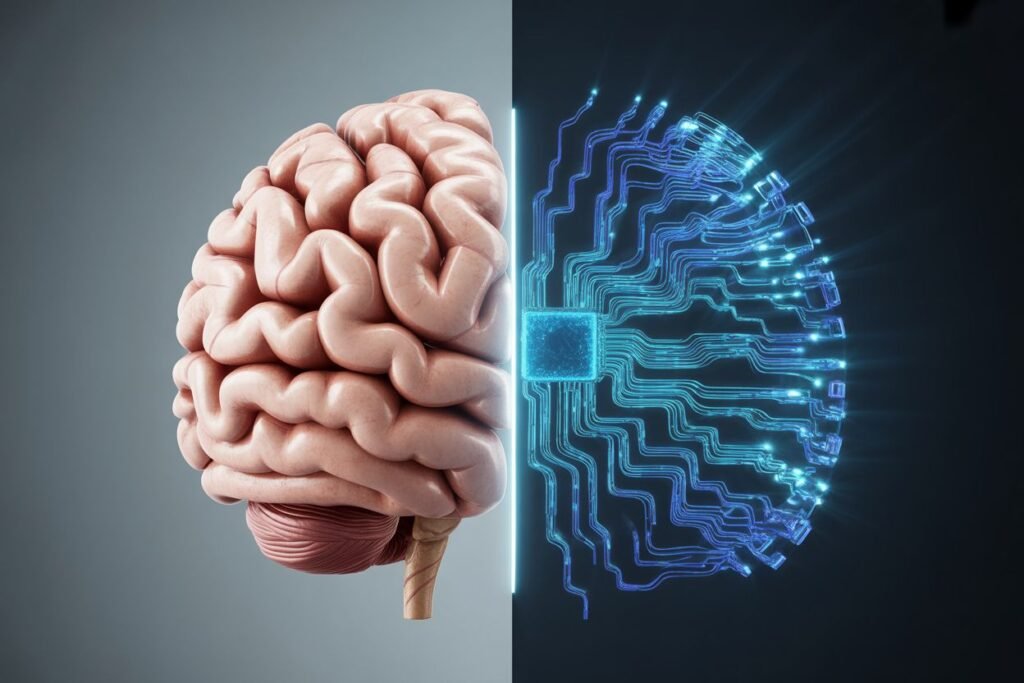

Ever wondered how your phone recognizes your face in a split second? Or how AI can generate realistic images from a simple text description? The answer lies in neural networks, a technology inspired by the most complex computer we know: the human brain.
Neural networks are the backbone of modern AI breakthroughs. They’re what makes machine learning so powerful and versatile. If you’re trying to understand artificial intelligence at a deeper level, grasping how neural networks work is essential. Let me walk you through it using simple analogies that actually make sense.
Your brain: the original neural network
Before we talk about artificial neural networks, let’s look at what inspired them. Your brain contains roughly 86 billion neurons, tiny cells that communicate with each other through electrical and chemical signals.
Each neuron connects to thousands of other neurons, creating a massive web of connections. When you learn something new, your brain strengthens certain connections and weakens others. This is how you remember faces, learn languages, and develop skills.
The fascinating part is that no single neuron holds complete information. Instead, patterns of activity across many neurons represent concepts, memories, and thoughts. When you see a dog, millions of neurons fire in specific patterns that your brain recognizes as “dog.”
This distributed processing makes your brain incredibly powerful and adaptable. Damage a few neurons and your brain can often rewire itself to compensate. That’s the kind of flexibility computer scientists wanted to recreate artificially.
What are artificial neural networks?
Artificial neural networks are computer systems loosely modeled after biological brains. They consist of layers of artificial neurons that process information and pass it along to the next layer.
Think of it like a relay race. Each runner (neuron) receives the baton (information), does their part, and passes it forward. By the time the baton reaches the finish line, the original information has been transformed into something useful, like a prediction or classification.
The beauty of neural networks explained simply is this: you don’t program them with specific rules. Instead, you train them with examples, and they figure out the patterns on their own. Just like your brain learned to recognize your mom’s face without anyone teaching you the geometric rules of facial recognition.
How artificial neurons actually work
An artificial neuron is much simpler than a biological one, but the core concept is similar. Each artificial neuron receives multiple inputs, processes them, and produces an output.
Imagine you’re deciding whether to go for a run. You consider multiple factors: the weather, your energy level, how much work you have, and whether your running shoes are clean. Each factor has different importance to you. Maybe weather matters a lot, but shoe cleanliness barely matters.
An artificial neuron works the same way. It takes multiple inputs, assigns each one a weight (importance), adds them up, and decides whether to activate based on that total. If the total exceeds a certain threshold, the neuron fires and sends its signal to the next layer.
Layers make the magic happen
A single neuron can’t do much. The power comes from connecting thousands or millions of neurons in layers.
The first layer receives raw input, like pixels from an image. These neurons look for simple features like edges or colors. They pass their findings to the next layer, which combines those simple features into more complex patterns like curves or corners.
Each layer builds on the previous one, creating increasingly abstract representations. By the final layer, the network can recognize complex concepts like “this is a cat” or “this person looks happy.”
The middle layers between input and output are called hidden layers. Deep learning simply means using neural networks with many hidden layers, allowing them to learn incredibly complex patterns.
Training a neural network from scratch
Creating a neural network is like raising a child. At first, it knows nothing and makes random guesses. Through repetition and feedback, it gradually gets better.
You start by showing the network thousands of examples. If you’re training it to recognize cats, you feed it images labeled as cat or not cat. Initially, the network makes terrible predictions because the weights between neurons are random.
After each prediction, you compare the network’s answer to the correct answer. If it’s wrong, you adjust the weights slightly to make the correct answer more likely next time. This adjustment process happens automatically through something called backpropagation.
You repeat this process millions of times. Gradually, the network learns which features matter for identifying cats. The weights settle into configurations that produce accurate predictions.
The training process requires massive amounts of data and computing power. That’s why neural networks only became practical recently, once we had both.
Real world applications you use daily
Neural networks power more of your daily life than you probably realize. Every time you unlock your phone with face recognition, neural networks are comparing your face to the stored template.
When you ask Siri or Alexa a question, neural networks convert your speech to text, understand what you mean, and generate an appropriate response. When you scroll through Instagram and see suspiciously relevant ads, neural networks analyzed your behavior to predict what you might buy.
Photo apps use neural networks to automatically enhance your pictures, adjusting brightness and color in ways that look natural. Translation apps can convert entire conversations in real time using neural networks trained on millions of text examples.
Even creative applications like AI art generators and writing assistants rely on neural networks. These systems learned patterns from existing content and can now generate new content that follows similar patterns.
The key differences between brains and artificial networks
Despite the inspiration, artificial neural networks are nothing like actual brains in many ways. Your brain runs on about 20 watts of power, roughly the same as a dim light bulb. Artificial neural networks training on powerful computers can consume thousands of watts.
Biological neurons fire much slower than artificial ones, but your brain compensates with massive parallelism. You can recognize a face in milliseconds using relatively slow biological components because billions of neurons work simultaneously.
Your brain also learns incredibly efficiently from just a few examples. Show a toddler three cats and they understand the concept. Artificial neural networks might need thousands of cat images to achieve similar performance.
Biological brains can also generalize better. You can recognize a cat even if you’ve never seen that specific breed before. Artificial neural networks often struggle when faced with situations too different from their training data.
Common misconceptions about neural networks
Neural networks are powerful but not magical. They don’t truly “understand” anything the way humans do. They’re pattern matching machines that learned associations from data.
A neural network trained to recognize cats doesn’t know what a cat is. It just learned that certain visual patterns correlate with the label “cat.” Show it a cat in an unusual pose or lighting, and it might fail completely.
These systems also can’t explain their reasoning. A doctor can tell you why they diagnosed a disease, but a neural network just outputs a prediction without explaining which features mattered most.
Another myth is that neural networks will automatically be fair and objective. They actually amplify biases in their training data. If you train a hiring network on historically biased decisions, it will learn to be biased too.
Where neural networks are heading
The field keeps evolving rapidly. Researchers are developing networks that need less data and computing power. Techniques like transfer learning let you adapt a pre-trained network to new tasks with minimal additional training.
Neuromorphic computing aims to build hardware that works more like biological brains, potentially making neural networks far more efficient. Quantum computing might eventually enable neural networks too complex for classical computers.
The goal is creating systems that learn more like humans do, from fewer examples, with better generalization. We’re still far from artificial general intelligence, but neural networks keep getting more capable each year.
Getting hands on with neural networks
You don’t need expensive equipment to experiment with neural networks. Frameworks like TensorFlow and PyTorch let you build and train networks on your laptop. Cloud platforms offer free tiers for running bigger experiments.
Start with simple projects like classifying handwritten digits or predicting house prices. Online tutorials walk you through building your first network step by step. The satisfaction of training a network that actually works is worth the effort.
Understanding neural networks gives you insight into both artificial and biological intelligence. You’ll never look at your brain or your phone the same way again.
Ready to see how neural networks learn from data? Our guide on what is machine learning explains the training process and different learning approaches that make these systems so versatile.
Retry