
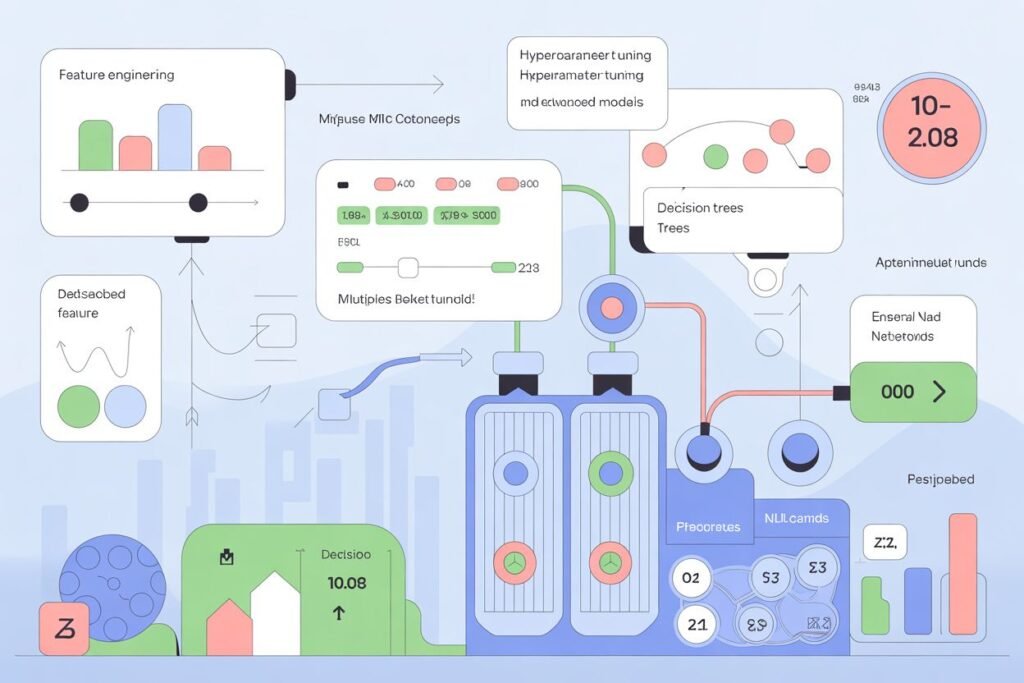

You’ve mastered the basics of machine learning. You can train linear regression and logistic regression models. You understand train test splits and evaluation metrics. Your models work reasonably well on simple datasets. But when you tackle real world problems with messy data and demanding performance requirements, your beginner skills hit their limits.
The gap between building tutorial models and production systems requires intermediate machine learning skills that most courses skip. You need to know how to engineer features that dramatically improve performance. You need systematic methods for finding optimal hyperparameters. You need to understand advanced algorithms like decision trees and ensemble methods that power most real applications.
These intermediate machine learning skills separate hobbyists from practitioners. Companies don’t deploy simple linear models on carefully cleaned academic datasets. They use sophisticated pipelines with extensive feature engineering, carefully tuned ensemble models, and production-ready workflows that handle real data complexity.
This comprehensive guide covers the essential intermediate skills you need. We’ll explore feature engineering techniques that often improve performance more than algorithm choice. We’ll cover hyperparameter tuning methods that systematically optimize model settings. We’ll dive into decision trees and ensemble methods that win competitions and power production systems. Finally, we’ll build complete pipelines that make your code reproducible and maintainable.
Whether you’re advancing your career, building real applications, or preparing for more advanced topics, these skills form the foundation. They’re practical, immediately applicable, and make a visible difference in your model performance. Let’s start with the skill that often matters most.
The transformative power of feature engineering
Raw data rarely arrives in optimal form for machine learning. Features might be on different scales, contain irrelevant information, or miss important relationships that exist in combinations of variables. Great models start with great features, and feature engineering in machine learning is the process of creating them.
Feature engineering encompasses three main activities: transforming existing features, creating new features from combinations, and selecting the most valuable features. Each activity can dramatically impact model performance, often improving results by 20, 50, or even 100 percent.
Feature scaling puts numerical features on similar ranges so no single feature dominates learning. When one feature ranges from 0 to 1000000 and another from 0 to 1, the large numbers can overwhelm gradients and distance calculations. Models struggle to learn appropriate weights when features live on vastly different scales.
Standardization transforms features to have mean zero and standard deviation one. Each value becomes how many standard deviations away from the mean it sits. This works well for features that roughly follow normal distributions and is preferred by algorithms like logistic regression and neural networks.
from sklearn.preprocessing import StandardScaler
import numpy as np
import pandas as pd

# Sample data with different scales
data = pd.DataFrame({
    'age': [25, 35, 45, 55, 65],
    'income': [30000, 50000, 70000, 90000, 110000],
    'score': [0.6, 0.7, 0.8, 0.9, 0.95]
})

# Standardize
scaler = StandardScaler()
data_scaled = pd.DataFrame(
    scaler.fit_transform(data),
    columns=data.columns
)

print("Original data:\n", data.head())
print("\nStandardized data:\n", data_scaled.head())
Normalization scales features to a fixed range, typically 0 to 1. Each value becomes its position between minimum and maximum values. This works well when you don’t want to assume distributions and is useful for algorithms like neural networks that benefit from bounded inputs.
Encoding categorical variables converts text categories into numerical form that models can process. The encoding method you choose affects how models interpret category relationships. One-hot encoding creates binary columns for each category, treating them as independent options with no inherent ordering.
Label encoding assigns each category a number, which is compact but creates false ordering. The model might interpret category 2 as between categories 1 and 3 when no such relationship exists. Use label encoding only for ordinal categories with natural ordering like education levels.
Target encoding uses the relationship between category and target variable. Each category gets encoded as the average target value for that category. This can be powerful but risks overfitting, especially with rare categories. Always use cross-validation when implementing target encoding.
Creating new features from existing ones often provides the biggest performance gains. Polynomial features create interactions and powers that help linear models capture non-linear patterns. From features x and y, you create x squared, y squared, and x times y. The model can now represent curved relationships using linear combinations.
Date and time features need special extraction. The raw timestamp contains little direct information, but components like day of week, month, hour, and whether it’s a weekend reveal useful patterns. Sales might spike on weekends. Server load might follow daily cycles. Extract these temporal patterns into separate features.
Domain knowledge guides the most valuable feature creation. If predicting customer churn, create features like days since last purchase, purchase frequency, and average order value. These domain-specific features often outperform raw transaction data because they capture what actually drives the behavior you’re predicting.
Feature selection removes features that add noise rather than signal. Not all features improve your model. Some are redundant, correlated with other features but providing no new information. Others are irrelevant, showing no relationship with your target variable. Removing them reduces overfitting and speeds training.
Correlation-based selection identifies redundant features. If two features correlate above 0.9, they provide similar information. Keep one and drop the other. This reduces dimensionality without losing information.
Model-based selection uses simple models to identify important features. Train a decision tree or linear model with L1 regularization. Examine feature importances or non-zero coefficients. Remove features with very low importance. This data-driven approach finds which features actually contribute to predictions.
The combination of proper scaling, thoughtful encoding, creative feature creation, and selective feature removal transforms raw data into optimized input for your models. This foundation is more important than the algorithm you choose next.
Systematic hyperparameter optimization
You built a model with great features and it works decently. But you know it could perform better with the right settings. The problem is finding those optimal settings among thousands of possible combinations without wasting days on manual experimentation.
Hyperparameter tuning explained provides systematic methods for finding the best configuration settings for your model. The difference between default settings and properly tuned hyperparameters often means 5 to 20 percent improvement in performance, sometimes even more.
Hyperparameters are settings you choose before training starts. Learning rate, number of trees in a random forest, maximum depth of decision trees, and regularization strength are all hyperparameters. These control how the model learns but aren’t learned from data themselves.
Parameters versus hyperparameters is an important distinction. Parameters are values the model learns during training. In linear regression, the coefficients are parameters. In neural networks, the weights are parameters. Training adjusts these to minimize loss. You never manually set parameters.
Hyperparameters require your decision before training begins. The model can’t learn its own best learning rate or optimal tree depth. You must try different values and evaluate which work best. This is where systematic tuning methods become essential.
Manual tuning fails for several reasons. First, it’s incredibly time consuming. Each combination requires training and evaluation. Trying dozens of combinations manually takes days. Second, you probably miss better configurations. The optimal learning rate might be 0.0073, but you only tried 0.01 and 0.001. Third, manual tuning lacks reproducibility and documentation.
Grid search is the exhaustive approach. You define a grid of values for each hyperparameter, and grid search tries every possible combination. With three values for two hyperparameters, you get nine combinations. With three values for four hyperparameters, you get 81 combinations.
from sklearn.model_selection import GridSearchCV
from sklearn.ensemble import RandomForestClassifier
from sklearn.datasets import make_classification
from sklearn.model_selection import train_test_split

# Create sample data
X, y = make_classification(n_samples=500, n_features=10, random_state=42)
X_train, X_test, y_train, y_test = train_test_split(X, y, test_size=0.2)

# Define parameter grid
param_grid = {
    'n_estimators': [50, 100, 200],
    'max_depth': [5, 10, 15],
    'min_samples_split': [2, 5, 10]
}

# Run grid search
grid_search = GridSearchCV(
    RandomForestClassifier(random_state=42),
    param_grid,
    cv=5,
    scoring='accuracy'
)

grid_search.fit(X_train, y_train)

print(f"Best parameters: {grid_search.best_params_}")
print(f"Best CV score: {grid_search.best_score_:.4f}")
print(f"Test score: {grid_search.score(X_test, y_test):.4f}")
Grid search advantages include completeness and simplicity. You’re guaranteed to find the best combination among specified values. The logic is straightforward. The disadvantage is computational explosion. Five hyperparameters with ten values each creates 100,000 combinations.
Random search samples random combinations from your specified ranges instead of trying everything. You specify distributions for each hyperparameter rather than discrete values. Learning rate might be sampled uniformly between 0.0001 and 0.1. Number of trees might be sampled between 10 and 500.
You control the budget by setting how many random combinations to try. Random search evaluates those combinations with cross-validation and returns the best. Research shows random search often finds good solutions faster than grid search, especially with many hyperparameters.
from sklearn.model_selection import RandomizedSearchCV
from scipy.stats import randint

# Define parameter distributions
param_distributions = {
    'n_estimators': randint(50, 300),
    'max_depth': randint(5, 20),
    'min_samples_split': randint(2, 20),
    'min_samples_leaf': randint(1, 10)
}

# Run random search
random_search = RandomizedSearchCV(
    RandomForestClassifier(random_state=42),
    param_distributions,
    n_iter=50,
    cv=5,
    scoring='accuracy',
    random_state=42
)

random_search.fit(X_train, y_train)

print(f"Best parameters: {random_search.best_params_}")
print(f"Best CV score: {random_search.best_score_:.4f}")
Use grid search when you have few hyperparameters and reasonable ranges. Use random search when you have many hyperparameters, large search spaces, or limited computing resources. A practical hybrid approach uses random search for broad exploration then grid search for refinement in promising regions.
Always use cross-validation during tuning. This provides reliable performance estimates and prevents overfitting to your validation set. Track all experiments to avoid retrying combinations and to understand what works.
Focus on the most important hyperparameters first. For random forests, number of trees and maximum depth matter most. Other hyperparameters have smaller effects. Don’t waste time tuning everything when a few key settings drive most of the performance.
Remember that optimal hyperparameters depend on your specific dataset. Settings that work for one problem might fail for another. Always validate on your own data rather than copying published hyperparameters.
Understanding decision trees and how they work
Linear models assume straight line relationships between features and targets. But real world patterns are often non-linear, with different rules applying to different regions of your data. Decision trees handle this complexity naturally through hierarchical splitting.
Decision trees explained simply are algorithms that make predictions by asking a series of yes/no questions about your data. Each question splits the data into groups, and this process continues until the tree reaches final predictions. Think of it like playing 20 questions to identify something.
The tree structure consists of nodes and branches. The root node contains all your data. Internal nodes ask questions that split data based on feature values. Leaf nodes provide final predictions. The path from root to leaf shows exactly how the tree reached its decision.
A tree predicting whether someone will buy a product might start by asking: is income greater than 50,000? If yes, go right. If no, go left. Each branch asks another question, continuing until reaching a leaf that predicts buy or don’t buy.
The beauty of decision trees is interpretability. You can draw the tree structure and see the exact decision rules. Compare this to neural networks where billions of parameters interact in ways impossible to visualize. Trees show their logic transparently.
Trees work for both classification and regression. Classification trees predict categories like spam or legitimate. Regression trees predict continuous values like house prices. The structure remains the same but leaf nodes contain different prediction types.
from sklearn.tree import DecisionTreeClassifier, plot_tree
import matplotlib.pyplot as plt

# Create and train tree
X, y = make_classification(n_samples=200, n_features=4, random_state=42)
X_train, X_test, y_train, y_test = train_test_split(X, y, test_size=0.2)

tree = DecisionTreeClassifier(max_depth=3, random_state=42)
tree.fit(X_train, y_train)

# Visualize
plt.figure(figsize=(15, 10))
plot_tree(tree, filled=True, feature_names=[f'feature_{i}' for i in range(4)])
plt.savefig('tree_structure.png')

print(f"Training accuracy: {tree.score(X_train, y_train):.4f}")
print(f"Test accuracy: {tree.score(X_test, y_test):.4f}")
How trees choose splits is critical to their effectiveness. Random splits would create useless trees. Trees need systematic methods to find the best splits at each node.
Gini impurity measures how mixed or pure groups are after a split. A pure group contains all examples from one class. A mixed group contains examples from multiple classes. Good splits create purer groups with lower Gini impurity.
Entropy measures disorder or randomness using information theory. Pure groups have entropy of zero. Mixed groups have higher entropy. Information gain measures how much entropy decreases after a split. Trees choose splits that maximize information gain.
In practice, Gini and entropy produce similar trees. Gini is slightly faster to compute. Entropy might create more balanced trees. Most practitioners use Gini as the default.
The tree evaluates every possible split for every feature. For numerical features, it considers splitting at every unique value. For categorical features, it considers splitting on each category. It picks whichever split reduces impurity most.
This process repeats recursively. After the first split creates two groups, the tree evaluates splits for each group independently. This continues until some stopping condition is met.
Without constraints, decision trees grow until every training example sits in its own leaf. The tree memorizes training data perfectly, achieving 100 percent training accuracy. But it fails on new data because it overfit to training noise and peculiarities.
Controlling tree growth prevents overfitting. Maximum depth limits how many questions the tree asks in sequence. A max depth of 5 means at most 5 splits from root to leaf. This prevents excessive specialization.
Minimum samples per split requires nodes to have at least this many examples before splitting. Setting this to 10 prevents splitting tiny groups where patterns might be random noise.
Minimum samples per leaf requires final prediction groups to have at least this many examples. This prevents tiny leaves with just one or two examples that overfit.
Maximum leaf nodes limits the total number of final prediction groups. The tree stops growing once it reaches this many leaves.
# Overfit tree (no constraints)
overfit_tree = DecisionTreeClassifier(random_state=42)
overfit_tree.fit(X_train, y_train)

# Constrained tree
good_tree = DecisionTreeClassifier(
    max_depth=5,
    min_samples_split=10,
    min_samples_leaf=5,
    random_state=42
)
good_tree.fit(X_train, y_train)

print("Overfit tree:")
print(f"  Train: {overfit_tree.score(X_train, y_train):.4f}")
print(f"  Test: {overfit_tree.score(X_test, y_test):.4f}")

print("\nConstrained tree:")
print(f"  Train: {good_tree.score(X_train, y_train):.4f}")
print(f"  Test: {good_tree.score(X_test, y_test):.4f}")
The overfit tree shows perfect or near perfect training accuracy but poor test accuracy. The constrained tree has lower training accuracy but better test accuracy because it learned general patterns instead of memorizing training details.
Decision tree advantages make them popular despite limitations. Complete interpretability lets you understand and explain predictions. They handle mixed data types naturally without preprocessing. They capture non-linear relationships and interactions automatically. They require minimal data preparation.
Disadvantages are equally important. Single trees overfit easily, especially on noisy data. They’re unstable, with small training data changes producing very different trees. They struggle with linear relationships that linear models capture easily. They create discontinuous predictions with sharp boundaries.
Trees work well for smaller datasets when interpretability matters most. For maximum predictive performance, trees are typically combined into ensembles that overcome individual tree weaknesses.
Ensemble methods: random forests and gradient boosting
Single decision trees overfit and produce unstable predictions. Yet combining many trees creates some of the most powerful machine learning algorithms available. Ensemble methods harness the wisdom of crowds principle: many mediocre models together often beat one sophisticated model.
Random forest vs gradient boosting represents two different philosophies for combining trees. Both work brilliantly but in different situations with different tradeoffs. Understanding when to use each method helps you build better solutions faster.
Ensemble learning combines multiple models to produce better predictions than any single model. For ensembles to work well, individual models need to make different kinds of mistakes. If all models fail on the same examples, combining them doesn’t help. But if they fail on different examples, their predictions balance each other out.
Random forests create diversity through two sources of randomness. First, each tree trains on a different random sample of training data. This bootstrap sampling or bagging means randomly selecting examples with replacement. You might pick the same example multiple times for one tree while excluding other examples entirely.
Second, at each split point each tree considers only a random subset of features. Instead of evaluating all features to find the best split, the tree picks a few random features and chooses the best split among those. This forces trees to use different features and prevents all trees from looking identical.
After training all trees independently in parallel, random forests make predictions by averaging all tree outputs for regression or taking a majority vote for classification. Each tree gets equal weight in the final prediction.
from sklearn.ensemble import RandomForestClassifier

# Train random forest
rf = RandomForestClassifier(
    n_estimators=100,
    max_depth=10,
    min_samples_split=5,
    random_state=42
)

rf.fit(X_train, y_train)

print(f"Random Forest train: {rf.score(X_train, y_train):.4f}")
print(f"Random Forest test: {rf.score(X_test, y_test):.4f}")

# Feature importances
importances = rf.feature_importances_
print(f"\nFeature importances: {importances}")
Random forests are robust and hard to mess up. They rarely overfit severely even with many trees. Adding more trees improves performance up to a point then plateaus. They handle high-dimensional data well and provide feature importance scores showing which variables matter most.
The main hyperparameters to tune are number of trees, maximum depth, minimum samples per split, and maximum features per split. More trees is almost always better but with diminishing returns after a few hundred.
Gradient boosting takes a completely different approach. Instead of training trees independently, it trains them sequentially with each tree learning to correct mistakes of previous trees.
The first tree trains on original data and makes predictions. Some predictions are accurate, others are way off. The second tree trains not on original targets but on the residuals or errors from the first tree.
The second tree learns patterns in what the first tree got wrong. It becomes specialized at fixing those errors. Add predictions of both trees together and you get better overall predictions than either tree alone.
This process continues for many iterations. Each new tree trains on residual errors after combining all previous trees. The final model sums predictions from all trees, with each tree contributing a correction.
A learning rate hyperparameter controls how much each tree contributes. Small learning rates mean each tree makes small corrections. This requires more trees but often produces better final models by preventing any single tree from dominating.
from sklearn.ensemble import GradientBoostingClassifier

# Train gradient boosting
gb = GradientBoostingClassifier(
    n_estimators=100,
    learning_rate=0.1,
    max_depth=5,
    random_state=42
)

gb.fit(X_train, y_train)

print(f"Gradient Boosting train: {gb.score(X_train, y_train):.4f}")
print(f"Gradient Boosting test: {gb.score(X_test, y_test):.4f}")
Gradient boosting is more prone to overfitting than random forests because later trees specialize in fixing training errors, which might include noise. Careful tuning of tree depth, learning rate, and number of iterations is essential.
The sequential nature means training can’t be parallelized like random forests. Each tree must wait for the previous one to finish. This makes gradient boosting slower to train on large datasets.
Key differences guide your algorithm choice. Training approach differs completely: random forests train trees in parallel, gradient boosting trains sequentially. This makes random forests faster on multi-core systems.
Prediction combination differs too. Random forests average independent predictions. Gradient boosting sums sequential corrections. Random forest predictions are more stable while gradient boosting predictions can be more accurate but also more sensitive.
Overfitting behavior differs significantly. Random forests rarely overfit severely. Adding more trees almost never hurts. Gradient boosting can easily overfit if you use too many trees or trees that are too deep.
Hyperparameter sensitivity differs. Random forests are relatively forgiving with reasonable defaults often working decently. Gradient boosting requires more careful tuning of learning rate, tree depth, and iterations.
Use random forests when you want a robust model with minimal tuning that works reasonably well out of the box. Choose them when training speed matters and when you have datasets with many features where some might be irrelevant.
Use gradient boosting when you need maximum predictive performance and have time to tune properly. Choose it when your dataset is clean and you can afford careful validation. Modern implementations like XGBoost, LightGBM, and CatBoost optimize gradient boosting for speed and performance.
import xgboost as xgb

# XGBoost for optimized gradient boosting
xgb_model = xgb.XGBClassifier(
    n_estimators=100,
    learning_rate=0.1,
    max_depth=5,
    random_state=42
)

xgb_model.fit(X_train, y_train)

print(f"XGBoost test: {xgb_model.score(X_test, y_test):.4f}")
For most projects, start with random forest as your baseline. It’s fast, robust, and works well with defaults. If you need better performance and have time to tune, try gradient boosting next with careful validation to avoid overfitting.
Often the best solution uses both. Train both random forest and gradient boosting models, then ensemble their predictions. Combining these complementary approaches can beat either one individually.
Building production-ready machine learning pipelines
You’ve engineered great features, tuned hyperparameters carefully, and trained a powerful model. But when you try to use it on new data, everything breaks. The preprocessing steps aren’t documented. You can’t remember which transformations to apply or in what order. Your code is scattered across notebooks with manual steps that can’t be reproduced.
Machine learning pipeline construction solves these problems by organizing your workflow into reproducible sequences. Pipelines chain preprocessing and modeling steps together, ensuring you apply the exact same transformations to training data, validation data, and new prediction data.
Without pipelines, your code probably involves manual steps scattered across cells or scripts. Load data, scale features, encode categories, split into train and test, train a model. When new data arrives, you scramble to remember which scaler you used and what the fitted parameters were.
Data leakage is a subtle but serious problem. You might accidentally fit your scaler on the entire dataset before splitting. Now information from your test set influenced scaling parameters, making evaluation metrics unrealistically optimistic. The model appears to work well but will fail on truly new data.
Cross-validation becomes a nightmare without pipelines. For each fold, you need to fit preprocessing on training data and apply it to validation data. Doing this manually for five folds is tedious and error prone. Miss one step and your results are invalid.
Pipelines fix all these issues by packaging preprocessing and modeling into a single object. Fit the pipeline on training data and it learns all necessary parameters. Transform new data and it applies the exact same preprocessing automatically. No manual tracking needed.
Sklearn’s Pipeline class chains transformation steps and a final estimator. Each step except the last must be a transformer with fit and transform methods. The last step is your model.
from sklearn.pipeline import Pipeline
from sklearn.preprocessing import StandardScaler
from sklearn.ensemble import RandomForestClassifier

# Build pipeline
pipeline = Pipeline([
    ('scaler', StandardScaler()),
    ('classifier', RandomForestClassifier(n_estimators=100, random_state=42))
])

# Train pipeline
pipeline.fit(X_train, y_train)

# Evaluate
print(f"Pipeline train: {pipeline.score(X_train, y_train):.4f}")
print(f"Pipeline test: {pipeline.score(X_test, y_test):.4f}")
The pipeline fits the scaler on training data, transforms training data, then trains the classifier on transformed data. When you call score on test data, it automatically applies the same scaling before predicting.
You access individual steps using their names. pipeline.named_steps[‘scaler’] gives you the fitted scaler. pipeline.named_steps[‘classifier’] gives you the trained model. The complexity is hidden inside the pipeline object.
Real datasets have mixed feature types requiring different preprocessing for different columns. ColumnTransformer applies different transformations to different column groups.
from sklearn.compose import ColumnTransformer
from sklearn.preprocessing import StandardScaler, OneHotEncoder

# Sample mixed data
data_mixed = pd.DataFrame({
    'age': [25, 35, 45, 55, 65],
    'income': [30000, 50000, 70000, 90000, 110000],
    'city': ['NY', 'LA', 'NY', 'SF', 'LA'],
    'purchased': [0, 1, 0, 1, 1]
})

X_mixed = data_mixed.drop('purchased', axis=1)
y_mixed = data_mixed['purchased']

# Column transformer
preprocessor = ColumnTransformer([
    ('num_scaler', StandardScaler(), ['age', 'income']),
    ('cat_encoder', OneHotEncoder(drop='first'), ['city'])
])

# Complete pipeline
full_pipeline = Pipeline([
    ('preprocessor', preprocessor),
    ('classifier', RandomForestClassifier(random_state=42))
])

full_pipeline.fit(X_mixed, y_mixed)
The ColumnTransformer applies StandardScaler to numerical columns and OneHotEncoder to categorical columns. Both transformations happen automatically when you fit or transform data through the pipeline.
This approach scales to complex preprocessing. Add as many transformation steps as needed for different column groups. The pipeline ensures consistent application across all data.
Pipelines integrate seamlessly with cross-validation. The crucial benefit is that preprocessing gets fitted separately for each fold, preventing data leakage.
from sklearn.model_selection import cross_val_score

# Cross-validation with pipeline
cv_scores = cross_val_score(
    full_pipeline,
    X_mixed,
    y_mixed,
    cv=5,
    scoring='accuracy'
)

print(f"CV scores: {cv_scores}")
print(f"Mean CV accuracy: {cv_scores.mean():.4f}")
For each fold, cross_val_score fits the entire pipeline on training portion and evaluates on validation portion. Preprocessing learns parameters only from training data, keeping validation data completely separate.
Grid search and random search work with pipelines using double underscore notation to reference pipeline steps: stepname__parametername.
from sklearn.model_selection import GridSearchCV

# Parameter grid for pipeline
param_grid = {
    'preprocessor__num_scaler__with_mean': [True, False],
    'classifier__n_estimators': [50, 100, 200],
    'classifier__max_depth': [5, 10, None]
}

# Grid search on pipeline
grid_search = GridSearchCV(
    full_pipeline,
    param_grid,
    cv=3,
    scoring='accuracy'
)

grid_search.fit(X_mixed, y_mixed)

print(f"Best parameters: {grid_search.best_params_}")
print(f"Best CV score: {grid_search.best_score_:.4f}")
This tunes both preprocessing parameters and model parameters simultaneously. The best parameters optimize the full workflow, not just the model in isolation.
Once trained, save your pipeline to disk for later use. Joblib handles serialization efficiently.
import joblib

# Save pipeline
joblib.dump(full_pipeline, 'trained_pipeline.pkl')

# Load pipeline
loaded_pipeline = joblib.load('trained_pipeline.pkl')

# Make predictions
new_data = pd.DataFrame({
    'age': [28],
    'income': [55000],
    'city': ['NY']
})

prediction = loaded_pipeline.predict(new_data)
print(f"Prediction: {prediction[0]}")
The saved pipeline includes all fitted preprocessing parameters and the trained model. Load it anywhere and it makes predictions exactly as if you just trained it. This is crucial for deployment.
Sometimes you need custom transformations not provided by sklearn. Create custom transformers by inheriting from BaseEstimator and TransformerMixin.
from sklearn.base import BaseEstimator, TransformerMixin

class LogTransformer(BaseEstimator, TransformerMixin):
    def __init__(self, features):
        self.features = features

    def fit(self, X, y=None):
        return self

    def transform(self, X):
        X_copy = X.copy()
        for feature in self.features:
            X_copy[feature] = np.log1p(X_copy[feature])
        return X_copy

# Use in pipeline
custom_pipeline = Pipeline([
    ('log_transform', LogTransformer(['income'])),
    ('scaler', StandardScaler()),
    ('classifier', RandomForestClassifier(random_state=42))
])
Custom transformers integrate seamlessly following the same fit and transform interface. This flexibility lets you implement any preprocessing logic while maintaining pipeline benefits.
Best practices make pipelines more maintainable. Keep pipelines simple and readable with clear step names. Version your pipelines along with code. Test pipelines thoroughly with unit tests verifying each step. Document what each step does and why. Monitor pipeline performance in production.
Production pipelines handle the complexity of real machine learning systems. They ensure reproducibility, prevent data leakage, and make code clean and maintainable. They’re not optional for serious work.
Preventing overfitting and underfitting
You’ve built sophisticated models with great features and careful tuning. But when you evaluate performance, something is wrong. Either your model achieves 99 percent training accuracy but only 60 percent test accuracy, or it performs poorly on both training and test data. These are the classic signs of overfitting and underfitting.
Understanding the balance between these two problems is critical for models that actually work in production. Your model needs to learn genuine patterns from training data without memorizing noise or missing important relationships.
Overfitting happens when your model learns training data too well, including random noise and peculiarities that don’t represent true patterns. The model performs excellently on training examples but poorly on new data. It memorized specific training instances rather than learning underlying rules.
Imagine studying for a test by memorizing all practice problems word for word. You’d ace those exact problems but struggle with any variation. That’s overfitting. Your model can recite training examples perfectly but can’t generalize to new situations.
from sklearn.preprocessing import PolynomialFeatures
from sklearn.linear_model import LinearRegression
from sklearn.metrics import r2_score

# Generate data with noise
np.random.seed(42)
X = np.linspace(0, 10, 20).reshape(-1, 1)
y = 2 * X.ravel() + 1 + np.random.normal(0, 1.5, 20)

X_train, X_test, y_train, y_test = train_test_split(X, y, test_size=0.3)

# Overfit model: high degree polynomial
poly_overfit = PolynomialFeatures(degree=15)
X_train_poly = poly_overfit.fit_transform(X_train)
X_test_poly = poly_overfit.transform(X_test)

overfit_model = LinearRegression()
overfit_model.fit(X_train_poly, y_train)

print(f"Overfit train R2: {overfit_model.score(X_train_poly, y_train):.4f}")
print(f"Overfit test R2: {overfit_model.score(X_test_poly, y_test):.4f}")
The overfit model achieves near perfect training accuracy but terrible test accuracy. The complex curve fits training noise that doesn’t appear in test data. Between training points, the curve makes wild swings that don’t reflect reality.
Signs of overfitting include large gaps between training and validation performance. If training accuracy is 95 percent but validation accuracy is 70 percent, you’re overfitting. Complex models are more prone to it. Deep neural networks can memorize entire datasets. Very deep decision trees create specific rules for tiny example groups.
Underfitting is the opposite problem. Your model is too simple to capture true relationships in your data. It performs poorly on both training and test data because it never learned the patterns.
An underfit model might fit a horizontal line through data that clearly trends upward. The line ignores the relationship between features and target, just predicting the average for everything.
# Underfit model: too simple
underfit_model = LinearRegression()
underfit_model.fit(np.ones_like(X_train), y_train)

train_pred = np.full_like(y_train, y_train.mean())
test_pred = np.full_like(y_test, y_train.mean())

print(f"Underfit train R2: {r2_score(y_train, train_pred):.4f}")
print(f"Underfit test R2: {r2_score(y_test, test_pred):.4f}")
Underfitting happens when models lack capacity to learn patterns. Linear models can’t capture non-linear relationships. Shallow decision trees can’t represent complex boundaries. Neural networks with too few neurons can’t learn much.
The goal is finding the right balance. A properly fit model performs reasonably well on training data and similarly on test data. A small gap between training and test performance indicates good generalization.
# Good fit model
good_model = LinearRegression()
good_model.fit(X_train, y_train)

print(f"Good model train R2: {good_model.score(X_train, y_train):.4f}")
print(f"Good model test R2: {good_model.score(X_test, y_test):.4f}")
The properly fit model has similar performance on training and test data. Both scores are reasonable, not perfect on training and terrible on test. This indicates generalizable learning.
Several techniques prevent overfitting once you recognize it. Collecting more training data is the most effective solution. More examples make it harder to memorize everything and easier to find real patterns.
Regularization adds penalties for model complexity. L1 and L2 regularization penalize large coefficient values in linear models. These techniques force models to learn simpler patterns that generalize better.
from sklearn.linear_model import Ridge, Lasso

# Ridge with regularization
ridge = Ridge(alpha=1.0)
ridge.fit(X_train_poly, y_train)

print(f"Ridge test R2: {ridge.score(X_test_poly, y_test):.4f}")
Early stopping prevents overfitting in iterative training. Monitor validation performance and stop when it starts degrading. The model at peak validation performance generalizes best.
Reducing model complexity helps too. Use fewer features through selection. Limit tree depth in decision trees. Use fewer layers in neural networks. Simpler models can’t overfit as severely.
Cross-validation provides better performance estimates and helps detect overfitting. Train on multiple data splits. If performance varies wildly across folds, you’re likely overfitting to specific data characteristics.
Fixing underfitting requires opposite solutions. Increase model complexity so it has capacity to learn patterns. Add more features through engineering. Use deeper trees or larger neural networks. Train longer if using iterative algorithms.
The bias variance tradeoff explains this balance mathematically. High bias models underfit because they make strong assumptions that don’t match reality. High variance models overfit because they’re too sensitive to training data fluctuations. You want low bias and low variance, but there’s usually a tradeoff.
Finding the optimal complexity requires monitoring both training and validation performance. Plot both as you increase model complexity. Training performance improves continuously. Validation performance improves then degrades as you start overfitting.
The optimal model complexity is where validation performance peaks. Before that point you’re underfitting. After that point you’re overfitting. This sweet spot produces models that work in production.
Conclusion
Intermediate machine learning skills transform you from someone who can follow tutorials to someone who can build production-quality systems. The techniques covered in this guide form the foundation that professional practitioners use daily.
Feature engineering often matters more than algorithm choice. Proper scaling puts features on comparable ranges. Thoughtful encoding converts categories to useful numerical representations. Creative feature creation captures relationships that raw data misses. Selective feature removal eliminates noise and redundancy. These transformations turn raw data into optimized model input.
Hyperparameter tuning systematically finds optimal model settings instead of relying on lucky guesses or defaults. Grid search exhaustively evaluates combinations when you have few hyperparameters. Random search efficiently explores large spaces with many hyperparameters. Both methods use cross-validation to prevent overfitting during the search process. Proper tuning often improves performance by 10 to 20 percent or more.
Decision trees provide interpretable models that handle non-linear relationships and mixed data types naturally. Understanding how trees split data using impurity measures, how to control their growth to prevent overfitting, and recognizing their strengths and weaknesses gives you powerful tools for many problems.
Ensemble methods combine multiple trees to achieve performance that individual trees cannot match. Random forests train diverse trees in parallel and average their predictions for robust results with minimal tuning. Gradient boosting trains trees sequentially to correct previous mistakes, achieving higher accuracy with careful tuning. Modern implementations like XGBoost and LightGBM make boosting practical for production use.
Machine learning pipelines organize workflows into reproducible sequences that prevent data leakage and ensure consistency. Pipelines chain preprocessing and modeling steps together, automatically applying transformations correctly to all data. They integrate with cross-validation and hyperparameter tuning. They save and load complete workflows for deployment. Pipelines are essential for production systems.
Understanding overfitting and underfitting helps you diagnose and fix model problems. Large gaps between training and test performance indicate overfitting that requires regularization, more data, or reduced complexity. Poor performance on both indicates underfitting that requires more capacity, better features, or longer training. Finding the right balance produces models that generalize well.
These skills work together in real projects. You engineer features to capture important patterns. You tune hyperparameters to optimize performance. You choose between random forests and gradient boosting based on your constraints. You build pipelines to make everything reproducible. You monitor for overfitting and underfitting throughout development.
The progression from beginner to intermediate machine learning involves moving beyond simple models on clean data. Real projects have messy data requiring extensive preprocessing. They demand strong performance requiring careful optimization. They need production deployment requiring robust pipelines.
Practice with real datasets cements these skills. Academic datasets are clean and well-behaved. Real data has missing values, outliers, mixed types, and complex relationships. Working through complete projects from raw data to deployed models builds the experience that separates practitioners from students.
The investment in intermediate skills pays enormous dividends. You can tackle problems that defeated you before. You can build systems that actually work in production. You can optimize performance to meet demanding requirements. These capabilities open career opportunities and enable you to create real value with machine learning.
Your next step depends on your goals. If you’re building production systems, focus on pipeline construction and deployment practices. If you’re competing in data science competitions, master advanced ensemble methods and aggressive feature engineering. If you’re preparing for deep learning, these fundamentals apply directly to neural network projects.
The common thread is hands-on practice. Reading about techniques provides understanding, but building projects develops mastery. Start with a dataset that interests you. Apply feature engineering to improve baseline performance. Tune hyperparameters systematically. Compare random forests and gradient boosting. Build a complete pipeline. Deploy your model and monitor its performance.
Every intermediate practitioner started where you are now. They learned these techniques, applied them to projects, made mistakes, debugged problems, and gradually developed intuition. The path is clear and accessible to anyone willing to invest the effort.
Ready to master the technique that often improves performance more than any algorithm switch? Start with feature engineering in machine learning to learn the practical transformations that turn raw data into model-ready features. This hands-on skill will immediately improve every model you build.


