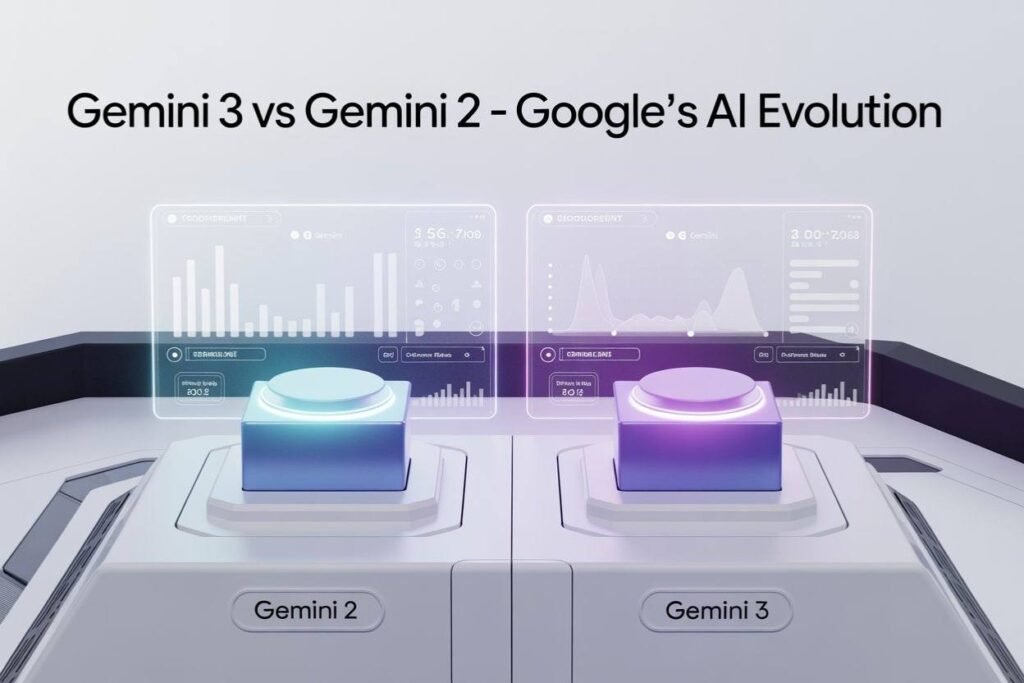

Google just dropped Gemini 3 on November 17, 2025, and if you’ve been using any previous version of Gemini, you’re probably wondering what actually changed. Not the marketing hype or the buzzwords, but the real improvements that matter when you’re trying to get work done.
I’ve spent time digging into the benchmarks, testing the capabilities, and comparing what Gemini 3 brings to the table versus Gemini 2 and 2.5.
What makes Gemini 3 different from previous models
The jump from Gemini 2 to Gemini 3 isn’t just another incremental update. Google rebuilt core parts of how this AI processes information, reasons through problems, and handles multiple types of content at once.
Gemini 1 introduced us to native multimodality, meaning it could work with text and images together instead of treating them as separate tasks. Gemini 2 pushed that further with longer context windows and early attempts at agentic behavior, where the AI could plan and execute tasks with less hand holding.
Gemini 3 takes all of that and adds a unified architecture that processes text, images, audio, video, and code in one go. No more separate systems trying to talk to each other. Everything runs through the same transformer stack, which means the AI understands how these different types of information relate to each other in ways the older models couldn’t.
Speed and performance improvements you’ll actually notice
Here’s something concrete. Gemini 3 runs about twice as fast as Gemini 2.5 when generating complex code or detailed answers. If you’re using AI for development work or research, that speed difference adds up quick over the course of a day.
The 1 million token context window carries over from Gemini 2.5, but Gemini 3 actually uses that space better. It can maintain coherence across longer conversations and reference earlier parts of your discussion without losing track of what you were talking about.
Factual accuracy got a serious boost too. On the SimpleQA Verified benchmark, Gemini 3 scored 72.1%. That might sound like just a number, but it translates to fewer hallucinations and more reliable information when you need the AI to get facts right for professional work.
Benchmark scores that tell the real story
Let’s look at the numbers that matter for everyday use.
Gemini 3 vs Gemini 2 benchmark comparison
| Benchmark | Gemini 2/2.5 | Gemini 3 | What it measures |
|---|---|---|---|
| MMLU | 85% | 90% | General knowledge and reasoning across subjects |
| SWE Bench Verified | Below 60% | 63 to 70% | Real world coding and debugging ability |
| MMMUPro | Lower | 81% | Understanding images, diagrams, and visual data |
| Video MMMU | Lower | 87.6% | Processing and analyzing video content |
| SimpleQA Verified | Lower | 72.1% | Factual accuracy without making things up |
| LMArena Elo | Not top tier | 1501 | How it performs against other AI models |
That 5 point jump on MMLU from 85% to 90% represents a significant leap in how well the model understands and applies knowledge across different domains. For context, this is one of the most respected benchmarks in AI evaluation.
The coding improvements stand out especially if you’re a developer. Gemini 2.5 could write decent code but struggled with complex debugging and multi file projects. Gemini 3 handles those scenarios much better, with performance on SWE Bench Verified reaching 63% and projected to hit 70% as the UI and code generation features mature.
Multimodal capabilities and why they matter
Both Gemini 2 and Gemini 3 handle multiple types of content, but the way they do it differs completely.
Gemini 2 used separate encoders for different content types. You could give it an image and text, and it would process them, but they were handled in different parts of the system and then combined. This worked fine for basic tasks but created limitations when you needed the AI to truly understand how visual and textual information connected.
Gemini 3’s unified architecture means when you upload a video with audio and ask it to explain what’s happening, it’s processing all of that together from the start. The visual frames, the audio content, and your text question all inform each other in real time.
This makes a practical difference when you’re doing things like analyzing data visualizations, reviewing video content for work, or trying to get the AI to understand context from multiple sources at once. The responses are more coherent because the model genuinely understands how everything relates rather than just stitching together separate analyses.
Deep Think mode and advanced reasoning
This is where Gemini 3 really separates itself from earlier versions. Deep Think mode gives the AI more time to work through complex problems instead of just generating the first plausible answer.
Gemini 2 could handle multi step reasoning to some degree, but it often needed you to break down complex problems into smaller chunks. Deep Think mode in Gemini 3 can tackle problems like those on Humanity’s Last Exam and ARCAGI2, which are specifically designed to test advanced logical reasoning that previous models struggled with.
If you’re using AI for research, strategic planning, or any task that requires actual thinking rather than just pattern matching, this capability matters a lot. The model can now follow longer chains of reasoning without losing the thread or making logical leaps that don’t hold up.
Agentic capabilities and workflow automation
Gemini 2 introduced some experimental agent features and tool use, but they were limited and needed constant oversight. You could set up basic automations, but they’d frequently need correction or would fail on edge cases.
Gemini 3 supports native, structured tool use with much better reliability. It can plan and execute multi step workflows like financial reconciliation, data processing pipelines, or content creation processes with minimal intervention.
The difference shows up in how autonomously it can work. Where Gemini 2 might complete three steps of a five step process before needing guidance, Gemini 3 can often handle the entire workflow if you set it up properly. This makes it actually useful for business automation rather than just an interesting experiment.
Coding and development improvements
For developers, the improvements in Gemini 3 vs Gemini 2.5 are substantial. Code generation accuracy increased noticeably, and the model understands project structure and dependencies better.
When you ask it to write a function, Gemini 2 would give you something that worked in isolation but might not fit well into a larger codebase. Gemini 3 considers context better, writes more maintainable code, and can actually debug its own outputs when things don’t work as expected.
The 63% score on SWE Bench Verified puts it ahead of most competing models and represents a real capability to handle professional development tasks. This benchmark tests whether AI can actually solve real GitHub issues from open source projects, not just write hello world programs.
Should you upgrade from Gemini 2 to Gemini 3
If you’re using Gemini casually for basic questions and simple tasks, the improvements in Gemini 3 might not revolutionize your experience. Both versions handle everyday queries fine.
But if you’re doing any of these things, the upgrade makes a real difference:
Working with multiple content types regularly, especially video or audio analysis. Building automation workflows that need to run reliably without constant supervision. Using AI for coding and development work beyond simple scripts. Handling complex reasoning tasks that require the AI to think through multi step problems. Processing large amounts of information where factual accuracy matters.
The speed improvements alone make Gemini 3 worth using if you’re running lots of queries throughout the day. Cutting generation time in half means you can get more done in the same amount of time.
The bottom line on Google AI comparison
Gemini 3 represents a genuine upgrade over Gemini 2 and 2.5, not just a marketing refresh with minor tweaks. The unified multimodal architecture, improved reasoning through Deep Think mode, better coding capabilities, and more reliable agentic features add up to a model that can handle professional tasks its predecessors struggled with.
The benchmark improvements back up what you’ll notice in actual use. Faster responses, fewer errors, better understanding of complex requests, and more reliable execution of multi step tasks.