
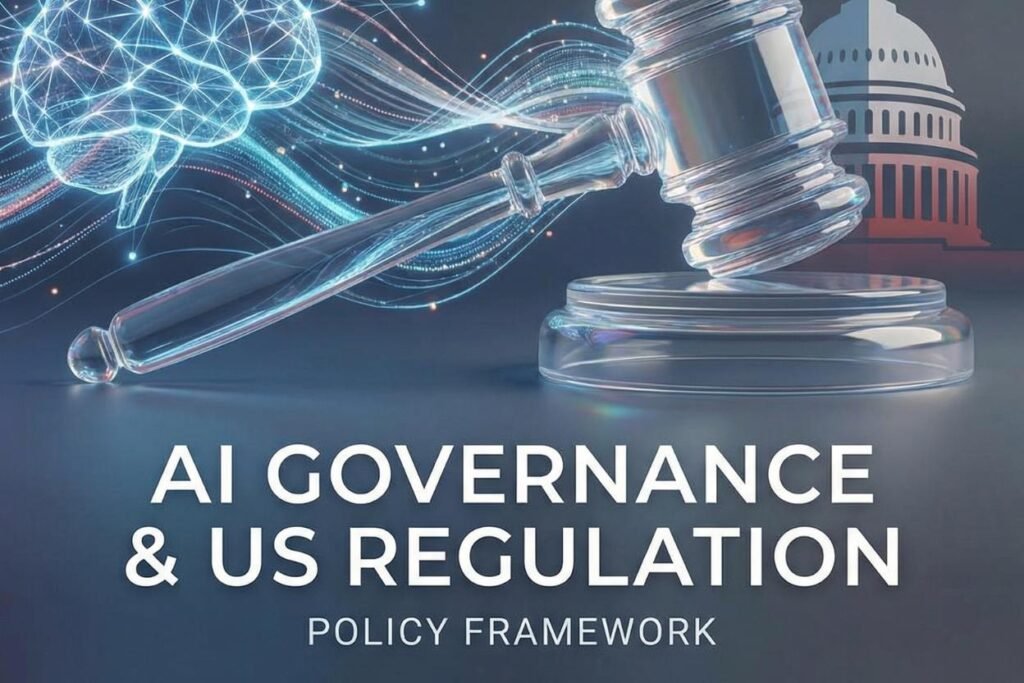

AI regulation is increasingly shaping how the United States balances rapid technological innovation with public safety, economic growth and individual rights. As AI systems influence jobs, healthcare, the justice system, finance and consumer technology, lawmakers, regulators and industry leaders are debating how much oversight is necessary without slowing American competitiveness and innovation in a global AI race.
In the US a comprehensive federal AI regulation framework has not yet been enacted. Instead AI regulation comes through executive actions, agency guidance and a growing patchwork of state laws that target specific risks and sectors. This makes AI governance in America complex but also a high‑stakes issue for policymakers, businesses and citizens alike as they navigate the benefits and risks of advanced intelligent systems.
what AI regulation means and why governance matters
AI regulation refers to the laws, policies and enforceable guidelines that govern how artificial intelligence systems are developed, deployed and used. It involves setting rules to manage risk, protect citizens and ensure the technology behaves in ways that align with public values and safety. AI governance is a broader concept that includes the frameworks, internal controls and ethical practices organizations adopt to ensure responsible AI use. At its core, governance creates guardrails for AI systems so they do not cause unintended harm or exacerbate social inequalities.
In practical terms this means a bank using machine learning to decide loan eligibility must be transparent about how decisions are made. It also means autonomous vehicle companies must meet safety standards before putting cars on public roads. Without effective AI regulation and governance, systems could unintentionally discriminate against certain groups or make opaque decisions that are hard to challenge.
the fragmented state of AI regulation in the United States
Unlike the European Union which passed a comprehensive AI Act for risk‑based regulation across all member states, the United States currently has no single federal AI law. US regulation relies on a mix of executive orders, federal agency guidance and state legislation.
At the federal level executive actions have shaped policy. One prominent example was an earlier Biden administration executive order on safe trustworthy AI that laid out broad principles for governance. That order directed agencies to consider issues like safety, privacy and bias. Under the current administration some of those policies were rescinded with a new emphasis on reducing regulatory barriers and promoting American leadership in AI development.
Federal agencies such as the Federal Trade Commission, Consumer Financial Protection Bureau and Department of Justice apply existing laws to AI‑related issues such as deceptive marketing, consumer harm and discrimination, demonstrating how AI regulation intersects with broader legal authorities rather than a distinct AI law.
At the same time states like Colorado, Utah and Texas have begun passing AI‑specific laws that impose transparency and accountability requirements for high‑risk systems or when AI is used in certain contexts. Colorado’s AI Act, for example, requires developers of high‑risk systems to protect consumers from foreseeable harm.
key themes in american AI governance debates
A few recurring themes define the current conversation about AI regulation in the US:
innovation vs oversight
Many US policymakers and industry leaders argue that too much regulation stifles innovation and economic growth. President Trump has publicly warned that overregulation could cede American leadership to China, calling for a unified federal standard instead of 50 different state schemes.
fragmentation vs uniformity
Because states are experimenting with their own AI laws, some federal policymakers argue for national standards to avoid a confusing patchwork that could burden businesses. A December 2025 presidential executive order tasked federal agencies with challenging state laws deemed “onerous,” emphasizing a national policy framework. Critics argue this could overstep constitutional limits and undermine states’ ability to protect citizens.
public safety and trust
Privacy, algorithmic bias, misinformation and safety outcomes remain core concerns in discussions around AI regulation. Civil liberties advocates emphasize that without proper governance AI systems could amplify discrimination or reduce accountability in high‑impact decisions. Meanwhile industry voices call for flexible standards that support responsible innovation without overly rigid constraints.
examples and debates shaping AI governance
American states have become key laboratories for AI regulation. Colorado passed a law that requires governance measures for high‑risk AI systems that impact areas like employment and housing. Other states like Utah have transparency requirements for consumer‑facing generative AI interactions.
In contrast, some federal proposals aim to preempt state regulation entirely. One House Republican bill included a 10‑year ban on state AI rules, sparking criticism that it would leave citizens unprotected while no federal law exists. Tech leaders such as the CEO of Anthropic publicly warned that such a ban is too blunt and urged development of national transparency standards instead.
States like California have also tried to lead with policies focusing on AI risk and transparency. Governor Newsom’s AI policy report highlighted “irreversible harms” that can occur without governance frameworks, demonstrating the urgency some states feel on this issue.
why AI governance is crucial for businesses
For companies operating in the US, AI governance is more than regulatory compliance. It’s about managing reputational risk, customer trust and long‑term sustainability. By adopting AI governance frameworks based on principles like fairness, transparency and accountability, organizations can reduce their legal and operational risks. Companies often align with voluntary standards such as the NIST AI Risk Management Framework, which offers structured guidance to manage AI risks across design and deployment without prescribing specific legal obligations.
Governance frameworks help businesses demonstrate due diligence. They also prepare firms to adapt quickly as regulatory landscapes evolve, especially in sectors like healthcare, finance and government procurement where oversight tends to be stricter.
public opinion and policy momentum in the US
Americans hold mixed views on AI oversight. Many see the potential for AI to transform healthcare, transportation and education. Yet there is also concern about privacy, algorithmic bias and job displacement without proper regulatory safeguards. These public attitudes influence both state and federal policy debates as policymakers try to respond to constituent concerns while supporting innovation.
Federal legislative efforts continue to focus on building consensus around how to regulate high‑risk applications, promote transparency and ensure civil rights protections without hampering technological advantage.
looking ahead balancing innovation and accountability
As AI systems become more capable and widely adopted across industries, the debate over AI regulation and governance in the United States will only grow. There is a clear need for frameworks that protect individuals and society while enabling businesses to innovate and compete globally. A balanced approach would combine clear, enforceable rules for high‑risk AI uses with flexible guidelines for emerging technologies.
Stronger AI governance can reduce risks such as algorithmic discrimination while building trust between the public, industry and government. At the same time overly rigid regulation could slow economic progress and hinder the rapid adoption of beneficial technologies. Finding the right balance will be a defining challenge for US policymakers and industry leaders in the years ahead.
conclusion on AI regulation and future governance in the US
AI regulation remains a central issue for American society as artificial intelligence becomes more integrated into daily life and business. Meaningful AI governance brings structure and accountability to how intelligent systems are built and used. It ensures that innovation does not come at the expense of safety, privacy, fairness, or civil rights.
For the United States, developing a coherent AI regulation strategy that both protects the public and supports innovation will be critical to sustaining global competitiveness and public trust. Achieving this will demand thoughtful policy design informed by stakeholder input, transparent governance practices and a commitment to responsible technology use that bridges federal standards and state experimentation.