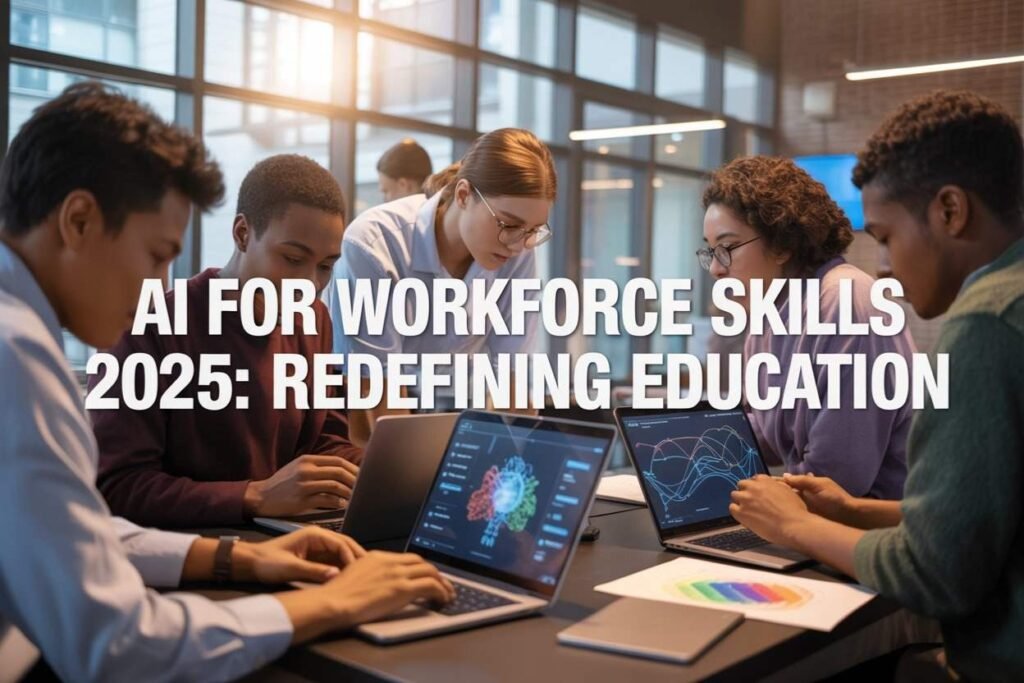

Artificial intelligence is not only changing how people work but also how they learn. In 2025, education is becoming more dynamic, more personal, and more aligned with real-world skills thanks to AI. This transformation is part of the larger shift where AI applications are redefining entire industries and how society functions. From schools to corporate training programs, AI systems are reshaping the way people gain knowledge and apply it in their jobs. The focus is no longer on memorization but on adaptability, creativity, and lifelong learning.
As automation takes over routine tasks, the demand for skills that complement intelligent systems has grown fast. Companies and educators are using AI to bridge the gap between traditional education and the modern job market. Whether it’s personalized learning platforms, skill-matching tools, or smart coaching systems AI is building a bridge between talent and opportunity.
Personalized learning paths for every student
Traditional education used to follow one path for everyone. Students learned at the same pace, using the same material, regardless of their strengths or weaknesses. AI has changed that completely
Modern learning platforms use AI to personalize the experience for each learner. They track progress, understand preferences, and adjust the content accordingly. If a student struggles with a specific topic the system provides more exercises or simpler explanations. If they master a concept quickly it moves them ahead
This level of customization helps students stay engaged and motivated. In 2025, many schools and online programs use adaptive learning systems that make education more flexible and efficient. These platforms can analyze thousands of data points from performance to attention span to create an experience that feels personal and effective.
For adults in the workforce AI-driven platforms do the same. Professionals can upskill in targeted ways, learning only what’s necessary for their specific goals. The result is faster learning and better retention.
AI mentors and virtual instructors
The idea of having a personal tutor used to be limited to a few. Now AI mentors are available to anyone with an internet connection. These virtual instructors can answer questions, explain complex concepts and provide feedback in real time.
In 2025, AI mentors are becoming more conversational and human-like. Using natural language processing, they can understand tone and intent. They adjust their teaching style based on the learner’s personality and progress. If a student prefers visual learning, the AI can use charts, videos or simulations. For someone who likes problem-solving, it can provide challenges and interactive exercises.
This makes learning more immersive and interactive. AI mentors are not replacing teachers but supporting them. Teachers now act as guides who focus on creativity, emotional intelligence and critical thinking while AI handles repetitive explanations and assessments.
Reskilling the workforce for an AI-driven economy
The job market is evolving faster than ever. Entire industries are being transformed by automation and data-driven processes. Many traditional roles are disappearing while new ones emerge in areas like machine learning, robotics and data ethics.
AI is helping workers adapt through reskilling programs that are faster and more effective. Corporate training platforms now use AI to identify skill gaps across teams and recommend personalized learning paths. If a company needs more data analysts or cybersecurity experts the system analyzes current employee skills and designs a learning plan to fill that gap.
This is especially important for industries like manufacturing, logistics, and customer service, where automation has created a need for new technical and analytical skills. Instead of being replaced, employees are being retrained to work alongside intelligent systems.
Governments and universities are also investing heavily in AI-driven education to ensure that people stay employable. Programs like micro-certifications and modular courses have become popular because they let professionals learn at their own pace while earning recognized credentials.
Data-driven education and performance insights
Education has always relied on evaluation, but AI has made it much more accurate and continuous. Instead of waiting for exams, learning platforms now provide real-time feedback and insights.
AI analyzes patterns in how students interact with content, how long they spend on questions, and where they make mistakes. This data helps teachers and administrators identify who needs support before problems grow. It also helps design better curriculums based on collective performance trends.
In workplaces, data-driven learning helps managers see which training programs deliver the best results. AI dashboards can show which employees are ready for promotion, who might need extra help, and what skills are most in demand across the organization.
This shift from reactive to predictive education is creating a smarter ecosystem. Both learners and instructors benefit from understanding progress in real time instead of relying on outdated testing models.
AI and emotional intelligence in learning
One of the most interesting developments in 2025 is the rise of emotional AI in education. These systems don’t just analyze performance they also read emotions through facial recognition, voice tone, and text patterns.
For example, if a student looks frustrated or bored, the AI system might slow down, offer encouragement, or change the learning format. It’s a subtle but powerful way to make education more empathetic.
Emotional AI also helps teachers better understand their students. Instead of guessing who might be struggling, teachers get insights backed by data. This creates a more supportive and human-centered classroom, even in virtual environments.
While some worry that emotional AI could invade privacy, most systems are being developed with strict ethical guidelines to protect user data. The goal is not surveillance but understanding.
The evolution of corporate learning culture
Companies in 2025 view learning as a continuous process, not a one-time event. With AI they can integrate training directly into daily workflows. Employees no longer need to leave their tasks to learn new skills the learning happens within the tools they already use.
For example, an AI assistant inside a project management platform might suggest tutorials or quick refreshers based on the task at hand. If an employee is struggling with a new feature, the system can provide immediate guidance.
AI is also making performance reviews more fair. Instead of relying solely on human judgment, companies can use data-driven insights to evaluate growth objectively. This makes development plans more transparent and aligned with real performance rather than personal bias.
Continuous learning driven by AI is turning workplaces into living classrooms where improvement never stops. Employees stay relevant, companies stay competitive, and both benefit from smarter learning ecosystems.
Challenges and ethics of AI in education
As powerful as AI is, it also raises important ethical questions. Data privacy is a top concern. Educational systems collect large amounts of personal information, from learning behavior to emotional patterns. Protecting that data from misuse is essential.
Bias is another challenge. If AI systems are trained on biased data, they can unintentionally favor certain groups or reinforce stereotypes. This is especially dangerous in grading or admissions systems. Developers are working on ways to make AI more transparent and fair, but it requires constant attention.
There’s also the human factor. While AI makes learning more efficient, it should never replace human connection. Teachers and mentors play an emotional role that machines can’t replicate. The best systems combine both AI for scale and precision, humans for empathy and guidance.
The future of education and skills in 2025
Education in 2025 is no longer about degrees but about skills. Employers care more about what people can do than what certificates they hold. AI is helping individuals prove their value through measurable outcomes and continuous learning records.
Micro-learning, immersive simulations, and gamified training are becoming mainstream. Students and professionals learn by doing, experimenting, and collaborating with AI systems that adapt as they grow. The relationship between learning and working is becoming seamless.
The future belongs to those who can learn, unlearn, and relearn. AI is not replacing humans but helping them evolve. It’s redefining what it means to be skilled in an intelligent world.
Education is shifting from a stage of life to a lifelong journey, and AI is the compass guiding it forward. The next generation of workers will be defined not by their job titles but by their ability to work intelligently with technology.
This same intelligence is transforming how people manage money, access credit, and protect their financial security. From fraud detection to personalized banking, AI is rebuilding the foundation of modern finance, proving that adaptive systems can create fairer and more efficient services across every aspect of daily life..