AI in education is no longer an experiment. It’s already embedded in how many American students learn, how teachers manage their workloads, and how school administrators track performance. The challenge now isn’t whether AI belongs in schools. It’s figuring out which applications actually help students and which ones create new problems that are harder to see than the ones they’re solving.
The stakes are high. Education shapes opportunity, and if AI in education widens existing gaps rather than closing them, the consequences ripple through generations. If it works the way its proponents describe, it could genuinely help every student learn at a pace and depth that matches their actual needs rather than the pace of a 30-person class.
Here’s what’s actually happening in US classrooms in 2026, what the research shows, and what the unresolved challenges are.
What AI in education actually means in practice
When educators or journalists say “AI in education” they’re usually talking about a few distinct things. Administrative AI automates routine tasks: tracking attendance, flagging at-risk students, generating progress reports, and scheduling. These applications don’t touch instruction directly but free up teacher time and give administrators better data faster.
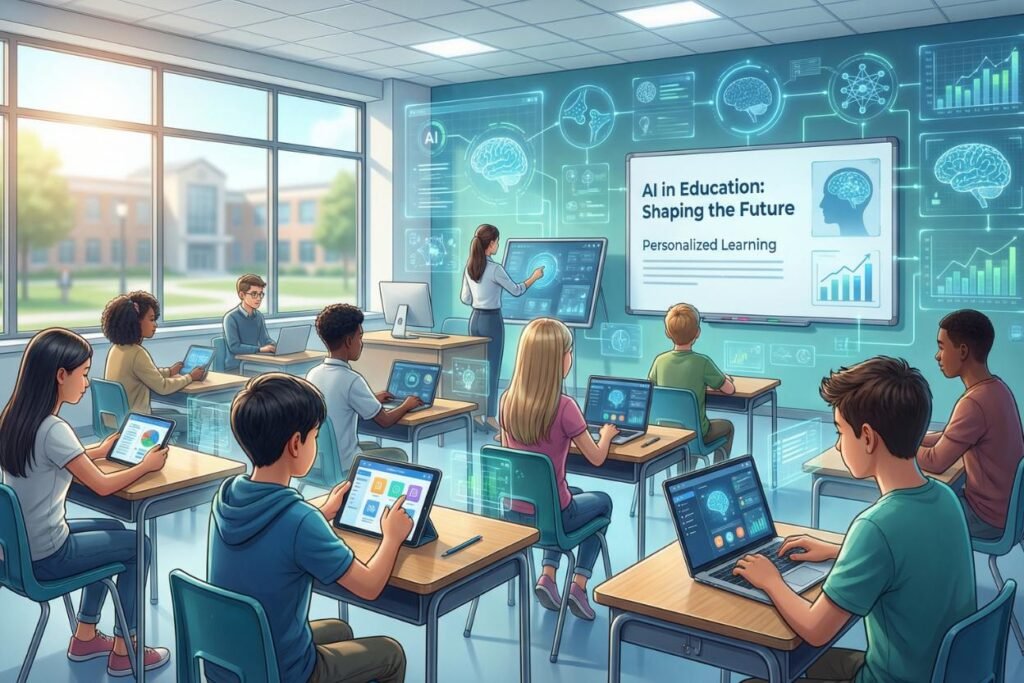
Instructional AI goes deeper. Adaptive learning platforms adjust content difficulty based on how a student responds in real time. An intelligent tutoring system doesn’t just tell a student they got a math problem wrong. It identifies the specific misconception that caused the error and delivers a targeted explanation. Natural language processing tools give students instant written feedback on essays or help English learners with pronunciation. AI classroom tools can also analyze engagement patterns across an entire class and flag students who may be disengaging before a teacher would naturally notice.
The distinction matters because the risks and benefits of these two categories are different. Administrative AI is relatively low-stakes and already widely adopted. Instructional AI, the kind that directly influences what a student learns and how, carries higher stakes and deserves more scrutiny.
Where AI in education stands in US schools right now
Adoption has grown significantly. Education Week Research Center data from recent years found that more than 70 percent of US educators reported using some form of AI tool in instruction or assessment. That number continued climbing through 2025 as more platforms integrated generative AI features and schools expanded digital tool budgets post-pandemic.
Urban districts like Los Angeles and New York have experimented with AI-powered analytics platforms that give teachers real-time dashboards of student progress. Colleges and universities use AI chatbots for enrollment, financial aid navigation, and academic advising. Some institutions have used predictive analytics to identify students at risk of dropping out early enough to intervene meaningfully.
AI in education: key figures for US schools | |||||
|
|
| |||
The federal government has also moved on this. The US Department of Education has published guidance on ethical AI use in schools, focusing on transparency, equity, and student data privacy. Multiple states have included AI literacy in their K-12 technology standards, reflecting an understanding that students need to understand the tools shaping their experience, not just use them.
AI in education examples that are actually working
Personalized learning platforms are the clearest success story so far. DreamBox and Khan Academy use AI to analyze how a student interacts with content and adjust what comes next accordingly. In math specifically, these platforms identify the precise skill a student is struggling with and deliver targeted practice rather than repeating the same lesson. RAND Corporation research found that students using intelligent tutoring systems improved math assessment scores compared to peers in traditional instruction-only settings.
Automated writing feedback tools have become a classroom staple. Grammarly, Turnitin’s AI writing features, and similar platforms give students immediate feedback on grammar, structure, and originality without waiting for a teacher to review a draft. Teachers report that these tools allow more iteration before submission, which tends to improve final quality. The questions around academic integrity are real, but tools for detecting AI-generated writing have also advanced alongside the writing assistance tools.
For students with special needs, AI tools offer meaningful support. Speech recognition helps students with dyslexia engage with reading tasks in ways that print alone doesn’t support. AI-powered predictive analytics can flag disengagement patterns for support staff before a student is failing. In special education, where individualized instruction is legally required and practically difficult to deliver at scale, AI tools offer a genuine lever for better outcomes.
Teacher workload reduction is another area producing real results. When AI takes on attendance tracking, progress report generation, and initial grading of standardized assessments, teachers report having more time for direct student interaction. Given that burnout and attrition are serious problems in US education, tools that reduce administrative burden without compromising instructional quality address a real systemic need.
The equity and access problem
Here’s the tension that doesn’t get resolved by any particular platform: AI in education benefits students who have reliable devices, fast internet, and teachers with time and training to implement new tools well. Those conditions are not evenly distributed across the US.
AI in education: the access divide | |||
|
| ||
Pew Research documented that roughly one in four lower-income US households lack high-speed internet access. Rural districts in particular face infrastructure gaps that no AI platform can bridge on its own. When AI-powered personalized learning is available in affluent suburban schools but not in underfunded rural or urban schools, the technology doesn’t close achievement gaps. It widens them.
AI model bias adds another layer. Systems trained on historical educational data inherit the patterns in that data, including the inequalities. If a predictive analytics system was trained primarily on data from well-resourced schools, its risk flags may not generalize accurately to students in different contexts. This can result in students being misjudged by a system that wasn’t built with their reality in mind.
Data privacy and what FERPA does and doesn’t cover
Student data privacy in the age of AI is genuinely complicated. The Family Educational Rights and Privacy Act was written in 1974 and gives parents the right to access and control their child’s educational records. But FERPA wasn’t designed for a world where third-party AI vendors process behavioral data, interaction logs, and learning patterns at scale.
Many AI education tools are provided by external companies that have their own data terms. Schools using these platforms must carefully evaluate whether vendor data practices comply with FERPA, state-level student privacy laws, and district policies. That due diligence requires legal and technical expertise that many underfunded districts don’t have in-house.
The US Department of Education has issued updated guidance encouraging schools to conduct vendor assessments and require contractual data protections before deploying AI tools. Some states have gone further with their own student data privacy legislation. But the overall framework still has gaps that can leave students’ learning data in ambiguous legal territory.
AI literacy as a core skill for students in 2026
Students who only consume AI tools without understanding how they work are in a weaker position than students who understand both the outputs and the mechanisms behind them. AI literacy, understanding what AI systems can and can’t do, how training data shapes model outputs, and how to critically evaluate AI-generated information, is becoming as important as traditional digital literacy.
Several US states have incorporated AI concepts into K-12 computer science standards. Universities increasingly offer courses on AI ethics, data science, and human-centered technology design. These aren’t just preparation for tech careers. They build the critical thinking skills that any citizen needs to navigate a world where AI influences hiring, credit, healthcare, and information access.
Community partnerships between schools and technology companies can expand access to these skills. Internship and apprenticeship programs focused on AI and data science help students connect classroom learning to real career pathways. Given that employers across nearly every sector are seeking workers with some level of AI fluency, these pathways matter for workforce readiness as much as for academic development.
What good AI in education actually requires
AI in education works best when it amplifies teacher judgment rather than replacing it. Adaptive platforms that tell teachers which students need attention, and in what specific ways, give educators actionable information they can act on. Platforms that generate automated recommendations without teacher input in the loop risk removing the human context that makes good teaching work.
Professional development is not optional. Most teachers feel underprepared to integrate AI tools effectively. Training programs that address both the technical operation of tools and the ethical questions they raise, around bias, data, and student agency, produce teachers who use AI thoughtfully rather than defaulting to whatever the platform suggests.
Sustained research matters too. Short-term test score improvements don’t tell the full story of what AI in education is doing to student development, creativity, critical thinking, and long-term learning habits. Longitudinal studies that follow students who learned with heavy AI involvement through to later educational and career outcomes will provide the evidence base that policymakers and educators actually need.
The question for America isn’t whether AI belongs in schools. It’s already there. The question is whether the deployment decisions being made now are guided by evidence and equity or primarily by convenience and cost. Getting that right will shape learning outcomes for a generation of US students.