
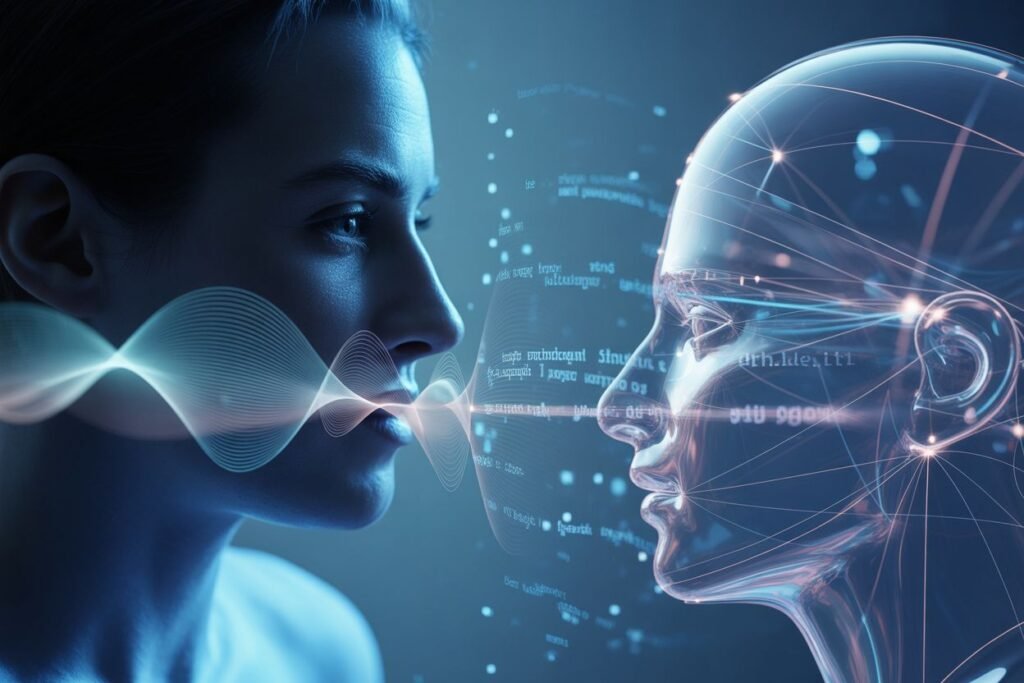

You talk to Siri, ask ChatGPT questions, and Google autocompletes your searches before you finish typing. Behind all these interactions sits natural language processing, the technology that lets computers understand and respond to human language.
Human language is messy, full of slang, sarcasm, and context that changes meaning completely. Teaching computers to handle this complexity is one of the biggest challenges in artificial intelligence. Yet somehow, your phone can transcribe your voice messages, translate foreign languages instantly, and even detect if a customer review is positive or negative. Let me show you how this actually works.
The challenge of understanding human language
Language seems effortless to us because we’ve been using it our whole lives. But think about how complex it really is.
The sentence “I saw her duck” could mean you witnessed someone lowering their head or you spotted their pet waterfowl. The word “bank” might refer to a financial institution or the edge of a river. We figure out the correct meaning from context without even thinking about it.
Sarcasm adds another layer of difficulty. “Oh great, another meeting” probably means the opposite of what the words literally say. Computers struggle with this because they lack the cultural knowledge and common sense that humans use automatically.
Different languages have different rules, structures, and idioms. What works for English might fail completely for Japanese or Arabic. Natural language processing has to account for these variations while still producing useful results.
What natural language processing actually does
Natural language processing bridges the gap between human communication and computer understanding. It takes the messy, unstructured text or speech we produce and converts it into something computers can analyze and act upon.
Think of NLP as a translator between humans and machines. When you ask your voice assistant a question, NLP converts your speech to text, figures out what you’re asking, determines the appropriate response, and converts that response back to speech.
But NLP does much more than basic translation. It can summarize long documents, identify key topics in thousands of emails, detect emotions in social media posts, and even generate human-like text from scratch.
The technology combines linguistics, computer science, and machine learning. It uses rules about grammar and syntax alongside statistical patterns learned from massive amounts of text data.
How computers break down language
Computers can’t understand language the way humans do, so they break it into smaller pieces they can process mathematically.
The first step is tokenization, splitting text into individual words or phrases. The sentence “I love AI” becomes three separate tokens: “I,” “love,” and “AI.” This sounds simple but gets tricky with contractions, punctuation, and compound words.
Next comes part of speech tagging, where the system identifies whether each word is a noun, verb, adjective, and so on. This helps determine the structure and meaning of sentences.
Named entity recognition identifies specific things like people’s names, locations, dates, and organizations. When you search for “Apple news,” the system needs to know whether you mean the company or the fruit.
Dependency parsing maps out how words relate to each other in a sentence. It identifies which words modify others and how different parts connect to form complete thoughts.
The evolution from rules to learning
Early natural language processing relied heavily on hand-coded rules. Linguists would write explicit instructions for handling grammar, vocabulary, and sentence structure. This approach worked for simple tasks but couldn’t scale to handle the full complexity of human language.
Modern NLP takes a different approach. Instead of programming rules, we train machine learning models on massive text datasets. These models learn patterns from examples, much like how you learned language as a child by hearing it used in context.
The breakthrough came with neural networks and deep learning. Models can now process entire sentences at once, capturing context and relationships between words. They learn that “bank” probably means a financial institution when surrounded by words like “account” and “deposit.”
Transformer models, the technology behind ChatGPT and similar systems, took this even further. They can handle much longer text and understand context across entire documents rather than just individual sentences.
Real applications you interact with daily
Natural language processing powers countless tools you probably use without thinking about the technology behind them.
Every time you type on your phone, autocorrect and predictive text use NLP to guess what you’re trying to say and suggest the next word. Your email spam filter analyzes message content using NLP to identify suspicious patterns.
Customer service chatbots use NLP to understand your questions and provide relevant answers. They can handle basic requests automatically, only escalating complex issues to human agents.
Social media platforms use NLP to moderate content, detecting hate speech, spam, and misinformation. Search engines use it to understand your queries and match them with relevant web pages.
Voice assistants like Alexa and Google Assistant rely entirely on NLP. They convert your speech to text, understand what you’re asking, retrieve the relevant information, and generate natural-sounding responses.
Translation apps can now convert conversations in real time between dozens of languages. While not perfect, they’re good enough for travelers to navigate foreign countries and communicate basic needs.
The different tasks NLP tackles
Natural language processing isn’t just one technique but a collection of specialized tasks, each solving different language problems.
Sentiment analysis determines whether text expresses positive, negative, or neutral emotions. Companies use this to analyze customer feedback at scale, spotting trends in thousands of reviews automatically.
Text classification sorts documents into categories. Email filters use this to organize messages into folders. News apps use it to recommend articles based on your interests.
Question answering systems extract specific information from text to answer direct questions. When you ask Google “how tall is the Eiffel Tower,” NLP finds that information in web pages and presents just the answer.
Text generation creates new content based on patterns learned from training data. This powers everything from automated report writing to creative writing assistants.
Named entity recognition extracts important information like dates, names, and locations from unstructured text. Financial firms use this to monitor news for mentions of companies they’re tracking.
The limitations you should know about
Despite impressive progress, natural language processing still has significant limitations. These systems don’t truly understand language the way humans do. They recognize patterns and correlations but lack genuine comprehension.
NLP models struggle with context that extends beyond their training data. Show them slang or references they’ve never seen, and they often fail. They also can’t reliably detect sarcasm, humor, or subtle emotional nuances.
Bias is a major concern. If you train an NLP model on text containing stereotypes or prejudices, the model learns and amplifies those biases. Researchers found that some language models associate certain professions with specific genders or ethnicities.
These systems also need enormous amounts of data and computing power to work well. Most languages lack sufficient digital text for training effective models. English dominates NLP research simply because more English text exists online.
Privacy concerns arise because NLP systems often require analyzing personal communications to function. Voice assistants that are always listening raise questions about surveillance and data security.
Where natural language processing is heading
The field keeps advancing rapidly. Models are getting better at understanding context across longer passages of text. They’re learning to handle multiple languages simultaneously rather than requiring separate models for each language.
Few shot and zero shot learning techniques let models handle new tasks with minimal or no specific training examples. This makes NLP more flexible and accessible for specialized applications.
Multimodal models combine language with images, audio, and video. They can describe pictures, answer questions about videos, or generate images from text descriptions.
Researchers are also working on making models smaller and more efficient so they can run on phones and other devices without requiring cloud computing. This improves privacy and reduces costs.
The goal is creating systems that understand language more like humans do, with better common sense reasoning and cultural awareness. We’re not there yet, but progress continues at a rapid pace.
Getting started with NLP yourself
You don’t need a research lab to experiment with natural language processing. Libraries like spaCy and NLTK provide ready-made tools for common NLP tasks. You can start building sentiment analyzers or text classifiers with just a few lines of code.
Cloud platforms offer APIs that let you add NLP capabilities to your applications without training models from scratch. You can implement translation, entity recognition, or sentiment analysis by simply calling their services.
Online courses walk you through NLP fundamentals and practical projects. Start with something simple like analyzing tweets to determine public opinion on a topic or building a basic chatbot.
The key is working with real text data. Grab some reviews, articles, or social media posts and try extracting insights. You’ll quickly see what works and what doesn’t.
Understanding natural language processing gives you insight into how modern AI actually processes information. It’s the bridge that lets machines interact with us in our own language rather than forcing us to learn theirs.
Want to understand the technology that makes NLP possible? Check out our guide on neural networks explained simply to see how these brain-inspired systems power language understanding.