
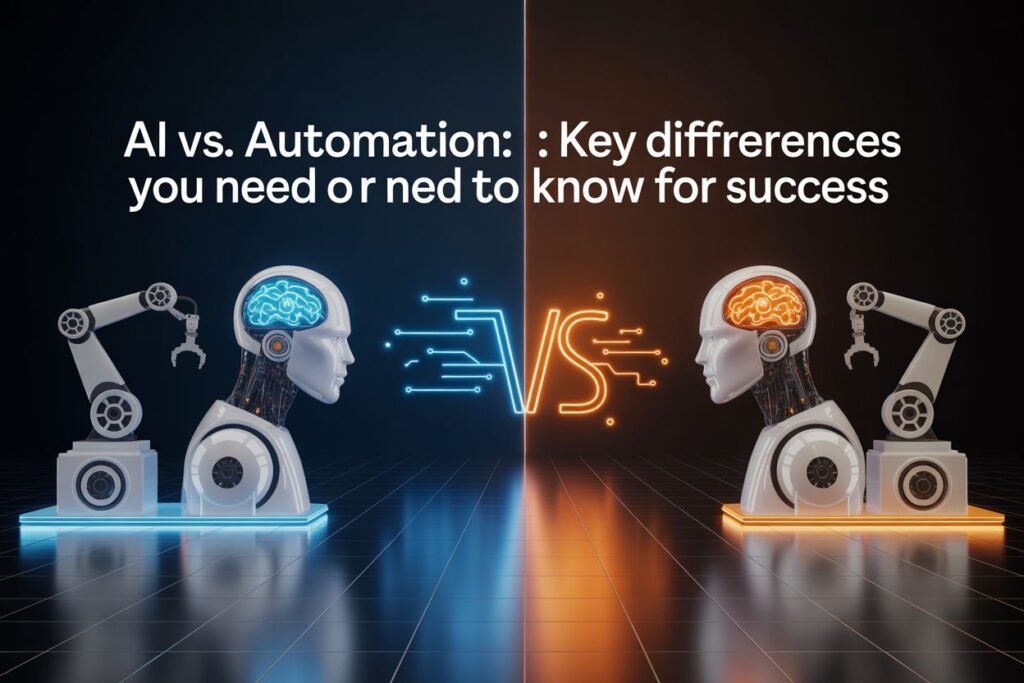

Artificial intelligence (AI) and automation are two terms that often get thrown around in business discussions. They’re sometimes used interchangeably, but in reality, they serve different purposes and operate in unique ways. Understanding the distinction between AI and automation is essential for businesses looking to harness these technologies effectively.
Both AI and automation have the potential to transform the way businesses operate, but knowing which one to use and when can be the key to success. In this article, we’ll explore the differences between AI and automation and provide insights on how you can use them in your business to drive efficiency, cut costs and improve overall performance.
What is Automation?
Automation refers to the use of technology to carry out tasks without human intervention. These tasks are typically repetitive and rule-based, such as data entry, processing orders or managing inventory. Automation is great for streamlining processes that don’t require much decision-making and are done the same way every time.
A good example of automation is an assembly line in manufacturing. Machines can perform the same set of tasks, such as assembling parts, without needing any input from workers. Automation tools are designed to reduce human error, improve efficiency and save time by handling mundane repetitive tasks.
While automation is a powerful tool, it’s not capable of making complex decisions. It’s based on pre-set rules, meaning it follows specific instructions to complete tasks but it can’t adapt to new situations or solve problems that fall outside of those instructions.
What is AI?
AI, on the other hand, is a much broader and more sophisticated technology. Unlike automation, AI is designed to mimic human intelligence. It can process information, make decisions, learn from experience, and adapt to new situations. AI is not limited to repetitive tasks; it can handle tasks that require problem-solving, creativity, and complex decision-making.
One of the most well-known examples of AI is virtual assistants, like Siri or Alexa. These AI systems don’t just follow simple commands they learn from user interactions to become more efficient over time. AI uses algorithms and data to make decisions based on patterns it recognizes. This ability to adapt and learn is what sets AI apart from traditional automation tools.
Key differences between AI and Automation
- Decision-Making Capability
- Automation: Follows pre-set rules to complete tasks without making decisions. It is ideal for repetitive tasks but lacks flexibility.
- AI: Can analyze data, learn from patterns, and make decisions on its own. AI has the ability to solve problems and adapt to new situations.
- Complexity of Tasks
- Automation: Works well with simple, repetitive tasks that have a clear set of instructions.
- AI: Handles complex tasks that require learning, pattern recognition, and problem-solving. AI can manage ambiguity and provide solutions based on data analysis.
- Learning Ability
- Automation: Does not have the ability to learn or improve over time. It operates based on pre-programmed rules.
- AI: Has the ability to learn and evolve over time. AI can analyze past data, recognize trends, and adjust its operations to be more efficient.
- Human Interaction
- Automation: Requires minimal human interaction once set up. It is designed to handle specific tasks with little or no oversight.
- AI: Can interact with humans in more natural and dynamic ways. AI systems can understand and respond to human input, making them more flexible in different environments.
When to use Automation
Automation is best suited for businesses that need to streamline processes that are repetitive, high-volume, and low-complexity. If your business involves managing large amounts of data, completing routine tasks, or providing standardized services, automation can save a lot of time and reduce the risk of human error.
For instance, automation is often used in the following areas:
- Email marketing: Automating email campaigns based on customer behavior or specific dates (e.g., birthday offers).
- Inventory management: Automated systems can reorder stock based on preset thresholds.
- Accounting: Automating invoices, payments, and financial reporting.
Automation will improve efficiency and allow you to scale your business operations without adding too many staff members.
When to use AI
AI, however, is more suited for tasks that require complex decision-making or a high level of interaction with customers. If you’re dealing with large amounts of unstructured data (such as customer feedback or social media interactions), AI can help you make sense of it all.
Some areas where AI can be particularly beneficial include:
- Customer service: AI-powered chatbots can engage with customers, answer questions, and learn from each interaction to improve future conversations.
- Marketing: AI can help personalize content, predict customer behavior, and optimize ad campaigns based on real-time data.
- Predictive analytics: AI can forecast trends and market shifts based on historical data, helping you make data-driven business decisions.
AI is a more advanced tool than automation and is ideal for businesses looking to innovate, improve customer experience, and stay competitive in a rapidly evolving market.
AI and Automation: A perfect pairing
While AI and automation are distinct technologies, they’re not mutually exclusive. In fact, combining both can lead to even greater efficiency and innovation in your business. For instance, you can use automation to handle repetitive tasks like data entry while using AI to analyze the data and provide insights for decision-making.
A good example of this combination is the way businesses use AI in marketing. Automation can handle the scheduling and sending of emails, while AI can analyze customer behavior to personalize those emails, improving engagement and conversion rates.